GHARP: Real-time Gaussian Head Animation from Large-scale Reconstruction Prior
Ali BenlalahSepehr JohariPatricia VitoriaArmin KappelerArtem SevastopolskyAlexander JungGabriele FanelliKevin MaderManuel BreitensteinClaudia Pl\"ussJan R\"ueggSimon BilandThomas EtterlinDmitry KostiaevMathias DeschlerBrian AmbergSebastian Martin
Oct 2026
Machine LearningComputer Vision
Abstract
We present GHARP (Real-time Gaussian Head Animation from Large-scale Reconstruction Prior), a method that animates 3D human heads in real time from a few input images of a subject and a driving expression signal. We decouple the problem into an identity stage that builds a representation of the subject's geometry and appearance offline, and an animation stage that predicts expression-dependent residuals on top of it at runtime. This separation offers a favorable trade-off with respect to fidelity, quality and runtime: the identity stage can be expensive while the animation stage runs a lightweight network, optimized for mobile devices. Our method performs animation in a semantically structured latent space of a pretrained reconstruction model, where expression changes remain spatially contained, making residual prediction efficient. This reconstruction prior provides a consistent spatial layout, allowing fusion of multiple input views into a compact, fixed-size canonical Gaussian representation. While this two-stage design improves the runtime-quality trade-off, it still inherits a problem common to all expression-driven avatar methods: expression codes describe only the face and thus omit body pose and clothing position, making these regions underspecified in the input. The animation network faces an ill-posed mapping and resorts to averaging over conflicting body appearances, producing blur and temporal flicker. We address this with a body alignment network that learns to align the person's body in the target image with the input reference images, removing the ambiguity from the training signal. Our method achieves state-of-the-art quality on the Ava-256 benchmark while running up to 13x faster on an A100 GPU with 8x fewer Gaussians.
This publication proposes a definition and a classification of agile software development approaches and analyses ten software development methods that can be characterized as being "agile" against the defined criterion.
P. Abrahamsson, O. Salo, Jussi Ronkainen et al.· arXiv.org· 727 citations· ⚡54
The study shows that agile practices improve both informal and formal communication, but indicates that, in larger development situations involving multiple external stakeholders, a mismatch of adequate communication mechanisms can sometimes even hinder the communication.
M. Pikkarainen, Jukka Haikara, O. Salo et al.· Empirical Software Engineeri...· 401 citations· ⚡48
The results indicate that software engineering work practices are chosen opportunistically, adapted and configured to provide value under the constrains imposed by the startup context.
Nicolò Paternoster, Carmine Giardino, M. Unterkalmsteiner et al.· Information and Software Tec...· 394 citations· ⚡54
The possibility of inferring high-dimensional data inference in a model that consists of a prior and an auxiliary differentiable constraint given some additional information is considered, thereby allowing a range of potential applications in adapting models to new domains and tasks.
Alexandros Graikos, Esmeralda S. Whitammer, N. Jojic et al.· Neural Information Processin...· 316 citations· ⚡15
Exploring how generative AI could make machine vision more accessible to businesses. The post GenEye in a Box: Making Machine Vision Something You Can Just Ask For appeared first on GPT-Lab.
Microsoft Research Blog· microsoft.comAug 11, 2026
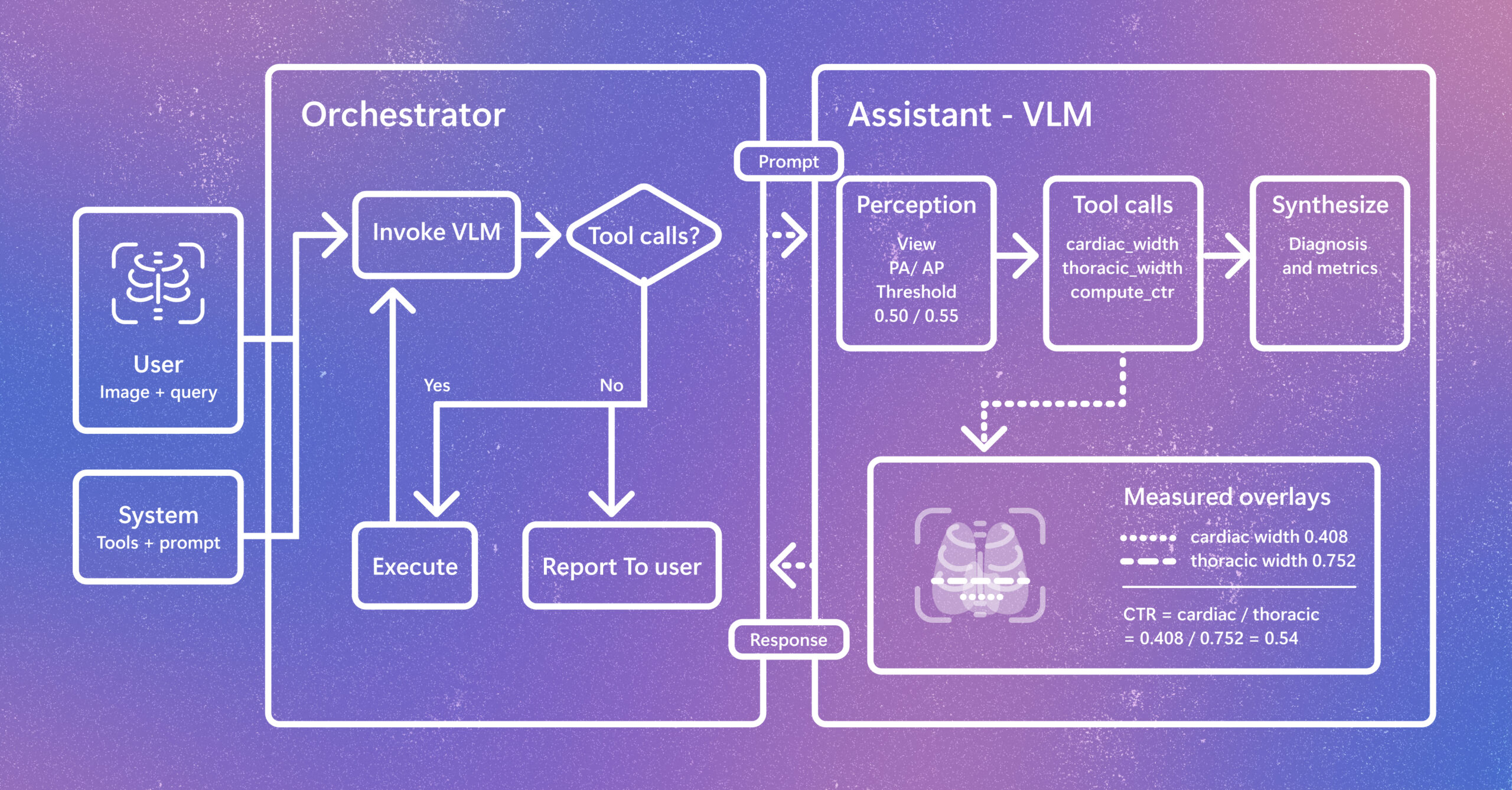
Radiology AI is evolving beyond report generation. CARE-X explores a unified approach that combines flexible reasoning, calibrated predictions, and measurement-based tools for chest X-ray interpretation. The post Introducing CARE-X: Towards Clinically Useful Radiology VLMs with Auxiliary Supervision, Reward-Aligned Learning, and Tool-Augmented Measurement appeared first on Microsoft Research.
Students in MIT’s Concourse program delve deeply into the human condition, debate challenging questions, and learn to develop judgment about issues that can’t be quantified.
We use cookies to run the site and, with your consent, for analytics and to show ads.
See our Cookie Policy.