Where Does the Semantic Gain Come From? A Reproduction and Extension of Semantic Knowledge-driven Contrastive Learning for Long-Tailed Recognition
Sushrut Ghimire
Oct 2026
Machine LearningComputer Vision
Abstract
Semantic Knowledge-driven Contrastive Learning (SKCL) uses a language model to decide which classes are related, and pulls each image towards the prototypes of its semantic neighbours. On CIFAR-100-LT (beta = 100) it reports 54.02% top-1 accuracy, 2.01 points above Balanced Contrastive Learning (BCL), the method it builds on. The code and the class descriptions are not public. I reimplement SKCL, BCL and ConCutMix in one framework, check it against the public baseline code, and run every configuration with three seeds. The two baselines reproduce within 1.5 points, but SKCL built on BCL, as the paper describes it, ends up 0.56 points below BCL. To find out why, I add SKCL to the authors' own ConCutMix code. Trained for the paper's 300 epochs, it reaches 53.69, only 0.33 below the published number. At the same budget, however, the semantic graph adds just 0.23 points over ConCutMix, while training ConCutMix for 100 more epochs adds 1.04. Together with ConCutMix's published lead over BCL (1.15), this explains the claimed gain. A BCL model that never sees the graph already shares 41.2% of the graph's top-2 neighbours with its own most-confused classes (2.0% by chance), which shows why the graph adds so little on these benchmarks. I also test several changes to SKCL. Combining it with the CutMix branch improves it by 1.06 points, and an adaptive version of the graph improves it slightly (+0.34 and +0.28 in two codebases), although these gains are within seed noise.
This publication proposes a definition and a classification of agile software development approaches and analyses ten software development methods that can be characterized as being "agile" against the defined criterion.
P. Abrahamsson, O. Salo, Jussi Ronkainen et al.· arXiv.org· 727 citations· ⚡54
The study shows that agile practices improve both informal and formal communication, but indicates that, in larger development situations involving multiple external stakeholders, a mismatch of adequate communication mechanisms can sometimes even hinder the communication.
M. Pikkarainen, Jukka Haikara, O. Salo et al.· Empirical Software Engineeri...· 401 citations· ⚡48
The results indicate that software engineering work practices are chosen opportunistically, adapted and configured to provide value under the constrains imposed by the startup context.
Nicolò Paternoster, Carmine Giardino, M. Unterkalmsteiner et al.· Information and Software Tec...· 394 citations· ⚡54
The possibility of inferring high-dimensional data inference in a model that consists of a prior and an auxiliary differentiable constraint given some additional information is considered, thereby allowing a range of potential applications in adapting models to new domains and tasks.
Alexandros Graikos, Esmeralda S. Whitammer, N. Jojic et al.· Neural Information Processin...· 316 citations· ⚡15
Exploring how generative AI could make machine vision more accessible to businesses. The post GenEye in a Box: Making Machine Vision Something You Can Just Ask For appeared first on GPT-Lab.
Microsoft Research Blog· microsoft.comAug 11, 2026
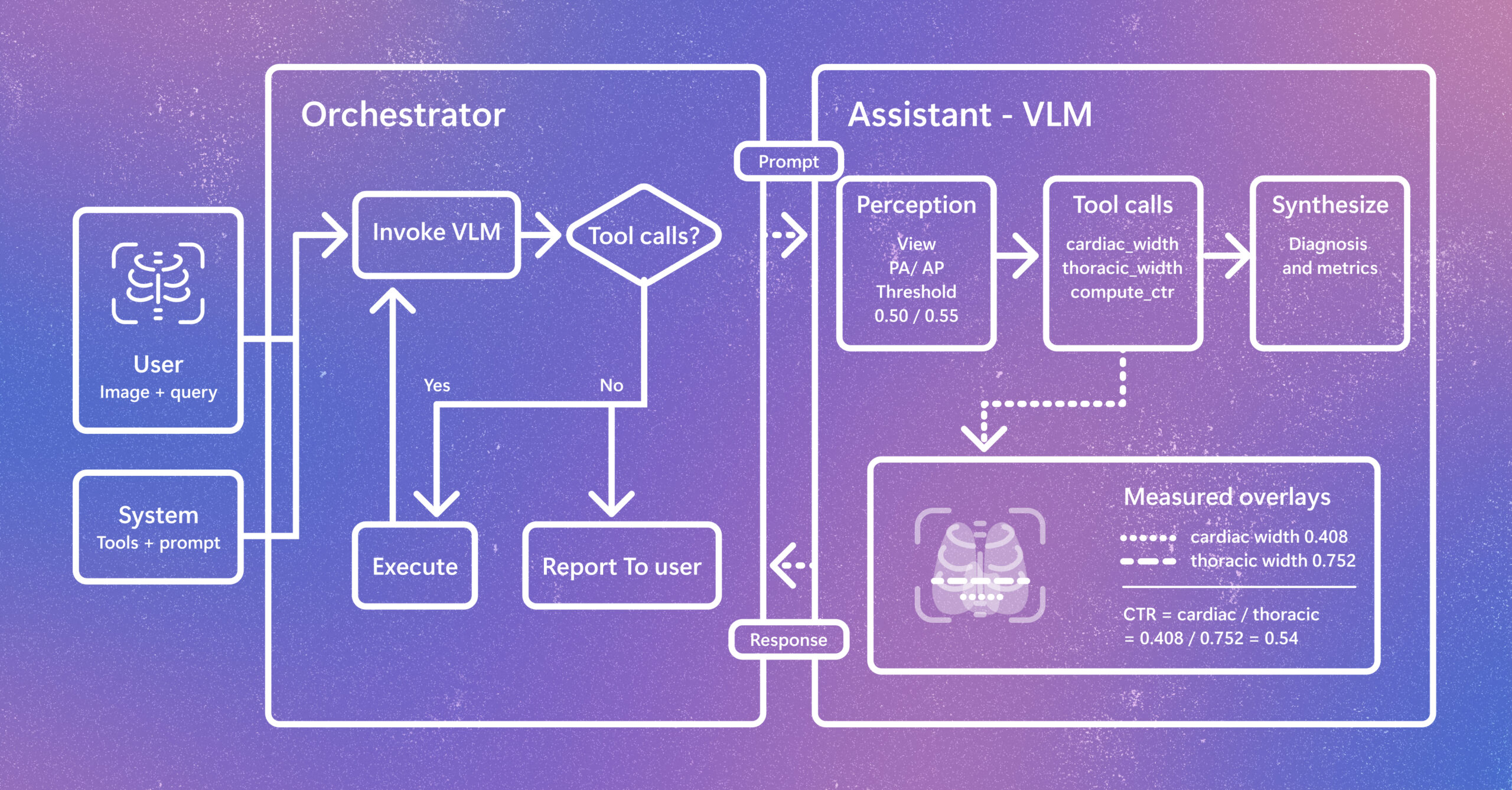
Radiology AI is evolving beyond report generation. CARE-X explores a unified approach that combines flexible reasoning, calibrated predictions, and measurement-based tools for chest X-ray interpretation. The post Introducing CARE-X: Towards Clinically Useful Radiology VLMs with Auxiliary Supervision, Reward-Aligned Learning, and Tool-Augmented Measurement appeared first on Microsoft Research.
Students in MIT’s Concourse program delve deeply into the human condition, debate challenging questions, and learn to develop judgment about issues that can’t be quantified.
We use cookies to run the site and, with your consent, for analytics and to show ads.
See our Cookie Policy.