Dynamic Quadtree Tokenization and Transformer for Adaptive Mesh PDE Forecasting
Yilin ZhuangNoah ZambranoKarthik Duraisamy
Oct 2026
Machine LearningComputer Vision
Abstract
The quadratic attention cost of Vision Transformers (ViTs) forces a trade-off between spatial resolution and rollout horizon, particularly for fine-scale PDEs where shocks, reaction fronts, and material interfaces occupy small, evolving regions of the domain. Conventional neural surrogates also lack mechanisms to adapt resolution dynamically. We propose WAMRViT, a ViT that tokenizes inputs as balanced quadtrees using a wavelet-inspired refinement criterion, jointly encodes position and refinement level with 3D rotary positional embeddings, and regrids in cell space during inference for stable long-horizon rollouts. A multi-scale variant retains each leaf at its native source resolution and lets the model learn across resolution levels. Unlike fixed-budget adaptive-tokenization methods, WAMRViT imposes no predetermined token count and supports fully adaptive topology throughout autoregressive rollout. To our knowledge, it is the first machine-learning surrogate to natively tokenize multi-level Adaptive Mesh Refinement (AMR) data. On uniform-grid benchmarks, uniform-patch WAMRViT improves finest-level region-of-interest VRMSE over a finest-patch uniform ViT while using substantially fewer tokens. The multi-scale variant achieves the lowest first-step full-field RMSE and VRMSE on both benchmarks and improves rollout-averaged full-field and refined-region accuracy at long horizons. With parallelized regridding, its end-to-end rollout cost lies between finest-patch and approximately token-matched coarser-patch ViTs. On a complex AMR combustion problem whose finest features cannot be represented natively by the evaluated uniform-grid baselines, WAMRViT operates directly on adaptive cells and substantially reduces finest-level error at matched transformer capacity. Code: https://github.com/tonyzyl/wamrvit
This publication proposes a definition and a classification of agile software development approaches and analyses ten software development methods that can be characterized as being "agile" against the defined criterion.
P. Abrahamsson, O. Salo, Jussi Ronkainen et al.· arXiv.org· 727 citations· ⚡54
The study shows that agile practices improve both informal and formal communication, but indicates that, in larger development situations involving multiple external stakeholders, a mismatch of adequate communication mechanisms can sometimes even hinder the communication.
M. Pikkarainen, Jukka Haikara, O. Salo et al.· Empirical Software Engineeri...· 401 citations· ⚡48
The results indicate that software engineering work practices are chosen opportunistically, adapted and configured to provide value under the constrains imposed by the startup context.
Nicolò Paternoster, Carmine Giardino, M. Unterkalmsteiner et al.· Information and Software Tec...· 394 citations· ⚡54
The possibility of inferring high-dimensional data inference in a model that consists of a prior and an auxiliary differentiable constraint given some additional information is considered, thereby allowing a range of potential applications in adapting models to new domains and tasks.
Alexandros Graikos, Esmeralda S. Whitammer, N. Jojic et al.· Neural Information Processin...· 316 citations· ⚡15
Exploring how generative AI could make machine vision more accessible to businesses. The post GenEye in a Box: Making Machine Vision Something You Can Just Ask For appeared first on GPT-Lab.
Microsoft Research Blog· microsoft.comAug 11, 2026
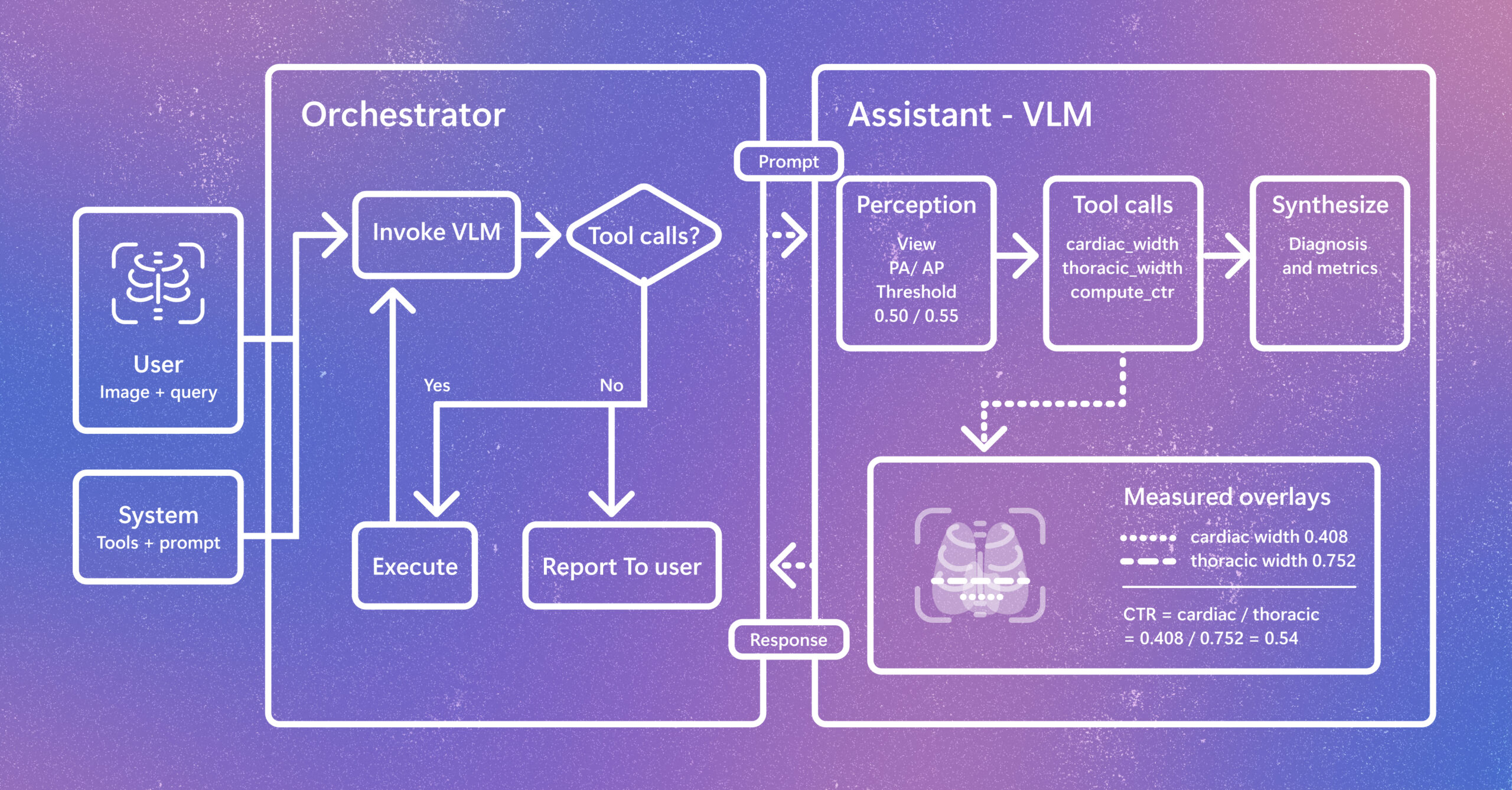
Radiology AI is evolving beyond report generation. CARE-X explores a unified approach that combines flexible reasoning, calibrated predictions, and measurement-based tools for chest X-ray interpretation. The post Introducing CARE-X: Towards Clinically Useful Radiology VLMs with Auxiliary Supervision, Reward-Aligned Learning, and Tool-Augmented Measurement appeared first on Microsoft Research.
Students in MIT’s Concourse program delve deeply into the human condition, debate challenging questions, and learn to develop judgment about issues that can’t be quantified.
We use cookies to run the site and, with your consent, for analytics and to show ads.
See our Cookie Policy.