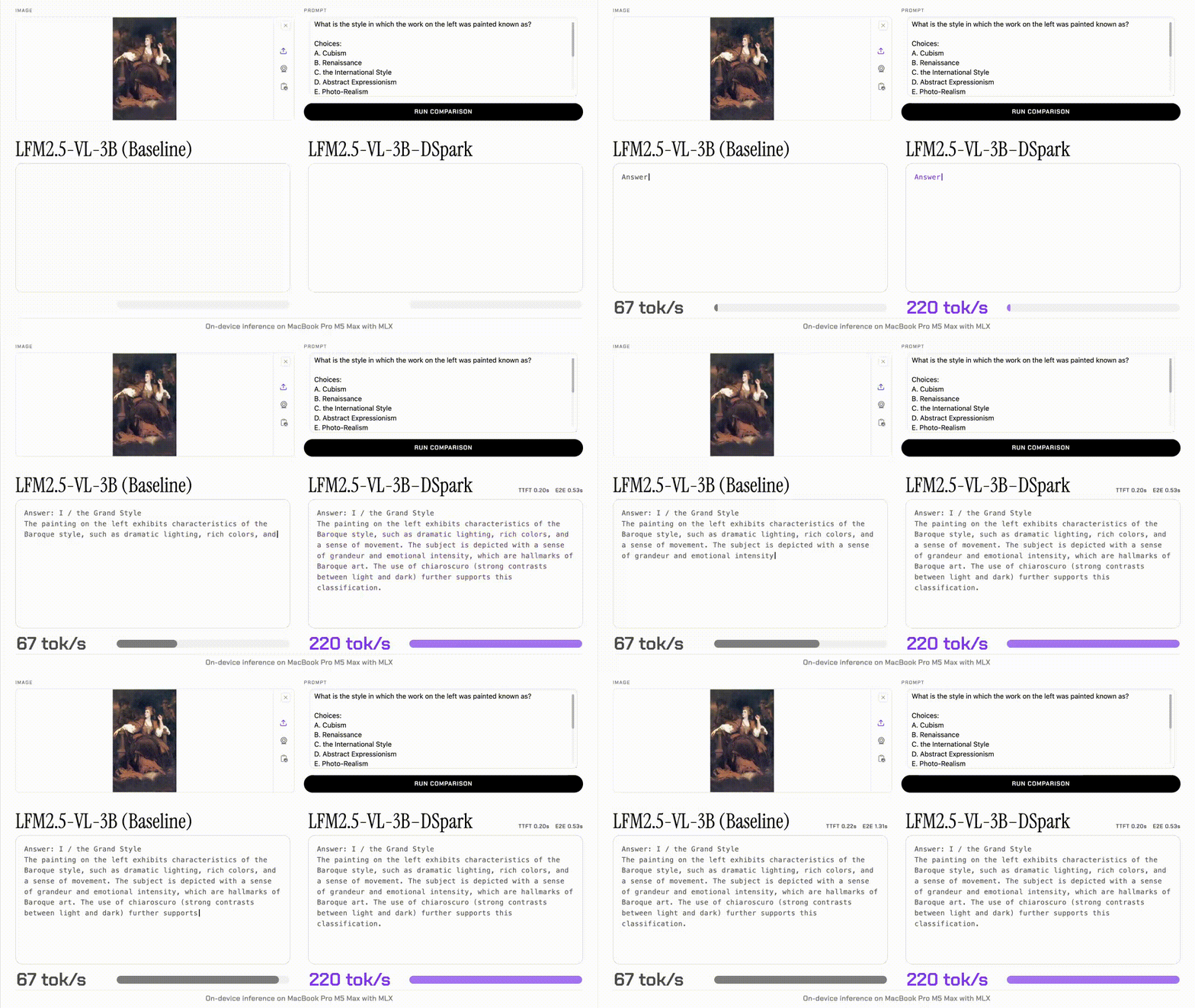
Simultaneous speech translation must emit useful target text before the source is complete while preserving every committed token. We adapt a full-utterance speech language model using prefix supervision derived from its own complete- and partial-waveform translations, requiring neither transcripts nor human translations. We compare single-turn forced-prefix and multi-turn append-only decoding, use a confidence threshold to control the inference-time quality--latency trade-off, and vary the density of training prefixes with a separate synthesis margin. On FLEURS and CoVoST2 in three language directions, prefix training improves quality--latency frontiers over the unadapted model, and confidence provides the broadest consistently competitive operating range. Multi-turn decoding is generally stronger at low latency; under multi-turn training, commit-calibration error falls by 63--68% overall and 68--80% at early prefixes, whereas single-turn training provides only modest overall calibration gains and no early-prefix improvement. A small synthesis margin sometimes extends the frontier to lower latency, particularly on shorter utterances, while a larger margin degrades translation quality and calibration. Prefix adaptation therefore improves simultaneous speech translation, especially under multi-turn append-only decoding, while synthesis density introduces a non-monotonic quality--latency trade-off.

This publication proposes a definition and a classification of agile software development approaches and analyses ten software development methods that can be characterized as being "agile" against the defined criterion.
P. Abrahamsson, O. Salo, Jussi Ronkainen et al.· arXiv.org· 727 citations· ⚡54
Supporting data, adapters, predictions and code for the article *Low-Cost LoRA Fine-Tuning of Small Language Models for Multi-Step Arithmetic Reasoning* by Jake O'Grady, Asena Isik Gürhan, Chee Fong Ting and Effirul Ramlan (University of Galway). We generated 20,000 GSM8K-derived arithmetic problems with step-by-step s...
O'Grady, Jake, Gürhan, Asena Isik, Chee, Fong Ting et al.· Zenodo (CERN European Organi...· 465 citations
Consequences of happiness and unhappiness that are beneficial and detrimental for developers' mental well-being, the software development process, and the produced artifacts are found.
D. Graziotin, Fabian Fagerholm, Xiaofeng Wang et al.· Journal of Systems and Softw...· 236 citations· ⚡13
The Mobile-D approach is briefly outlined here and the experiences gained from four case studies are discussed, which helped develop an agile development approach for mobile application development.
P. Abrahamsson, Antti Hanhineva, H. Hulkko et al.· Conference on Object-Oriente...· 225 citations· ⚡18
GAOKAO-Bench is introduced, an intuitive benchmark that employs questions from the Chinese GAOKAO examination as test samples, including both subjective and objective questions that contribute a robust evaluation benchmark for future large language models and offers valuable insights into the advantages and limitations...
Xiaotian Zhang, Chun-yan Li, Yi Zong et al.· arXiv.org· 216 citations· ⚡17
A study with 42 participants investigates the relationship between the affective states, creativity, and analytical problem-solving skills of software developers and offers support for the claim that happy developers are indeed better problem solvers in terms of their analytical abilities.
D. Graziotin, Xiaofeng Wang, P. Abrahamsson· PeerJ· 216 citations· ⚡13
Related blog posts
MIT News · Artificial Intelligence· news.mit.eduSep 24, 2026
With millions of users across the world, Julia has been used to conduct cutting-edge research and to design new drugs, jet engines, heat pumps, and more.
We use cookies to run the site and, with your consent, for analytics and to show ads.
See our Cookie Policy.