Skip to content

OpenTSLM TeeMoE: A Unified Time-Series Language Model for Forecasting, Contextual Prediction, and Reasoning

Sep 2026 · arXiv.org · Vol abs/2609.40265 · 0 citations · 72 references
Computer Science

TL;DR

OpenTSLM TeeMoE is introduced, a generalist time-series language model that can forecast directly from observed time series, reason over textual context and temporal patterns, and synthesize and refine predictions from external numerical forecasting specialists.

Abstract

Real-world time-series applications increasingly require models that can handle time series forecasting, context-conditioned prediction, and language-based temporal reasoning. Yet current time-series foundation models remain fragmented across these capabilities: numerical specialists often provide the strongest forecasts, while language-based models offer broader contextual understanding and analysis. A central challenge is to unify these heterogeneous capabilities without reducing their individual performance. We introduce OpenTSLM TeeMoE, a generalist time-series language model that can forecast directly from observed time series, reason over textual context and temporal patterns, and synthesize and refine predictions from external numerical forecasting specialists. We independently train three low-rank experts for forecast aggregation, native forecasting, and temporal analysis over a shared backbone. A learned LoRA mixture-of-experts controller then weights their frozen parameter updates for each request. Our proposed model achieves strong performance on widely used benchmarks for time series forecasting, context-conditioned prediction, and language-based temporal reasoning, ranking among the top three on GIFT-Eval by mean MASE rank, Context is Key by RCRPS, and TimeSeriesExam by accuracy.

View source

Similar papers

#artificial intelligence Preprint Sep 2026

TimeBraid: Unifying Time Series and Language for Understanding and Forecasting

TimeBraid, a series of unified time-series and language models that align pretrained language models and pretrained time-series foundation models through interleaved global residual attention layers, remains competitive with far larger general-purpose models and task-specific counterparts.

Xin-Yue Wang, Jia-Cheng Pang, Kun Zhou et al. · 0 citations
#machine learning Preprint Oct 2026

TMAML: Temporal Model-Agnostic Meta-Learning for Cold-Start Time Series Forecasting

Cold-start forecasting, the task of forecasting a time series with little to no historical data, is a common challenge. Addressing it requires approaches that learn quickly from few datapoints and leverage information from related series, typically through static covariates, to generalize well to unseen series. While s...

Wannes Janssens, Matthias Bogaert, D. van den Poel · 0 citations
#machine learning Preprint Aug 2026

A Human-in-the-Loop Autonomous Agent for Industry Time Series Forecasting

CastClaw is presented, a human-in-the-loop autonomous forecasting system built through forecasting-oriented harness engineering that connects data, specialized models, analytical tools, user input, and a versioned execution record in one runtime.

Xiao-Yu Tao, Ming-Yue Cheng, Ze Guo et al. · 0 citations
#artificial intelligence Preprint Oct 2026

AdaCast: Conditional Parameter Generation for Adaptive Time Series Forecasting

Time-series foundation models (TSFMs) have achieved strong forecasting performance across domains. However, most adaptation methods remain static. Existing all-in-one methods learn a single set of dataset-level parameter updates and apply the same adapted model to every input. As a result, they cannot adapt the model p...

Darahaas Nallagatla, Darryl C. Jacob, Pan He · 0 citations

Aurora-X: Built for Extreme Time Series Forecasting

A novel pattern-guided mixture-of-experts that expands model capacity through sparse activation and uses shallow patch similarities to constrain deep-layer routing, guiding expert specialization across heterogeneous time series and an implicit quantile network head that predicts arbitrary quantiles to characterize pred...

Xingjian Wu, Chen-Juan Guo, Xiangfei Qiu et al. · 0 citations

Related blog posts

Microsoft Research Blog Nov 16, 2026

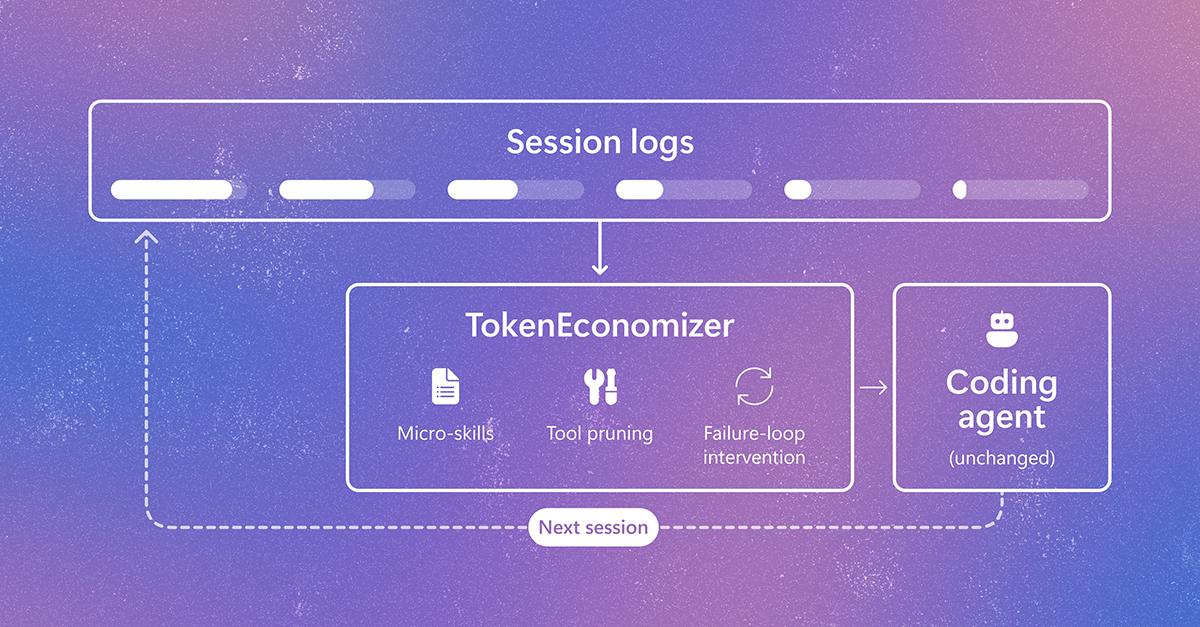
TokenEconomizer: Learning from Experience to Make AI Coding Agents More Efficient

AI coding agents are increasingly help developers fix bugs and build features largely on their own, but every interaction with their models consumes tokens. In each session, an agent sends instructions, tool descriptions, and session history to its model. Most efforts to reduce this cost focus on individual tasks. Yet developers return to the same […] The post TokenEconomizer: Learning from Experience to Make AI Coding Agents More Efficient appeared first on Microsoft Research.

We use cookies to run the site and, with your consent, for analytics and to show ads. See our Cookie Policy.