Diffusion models generate data by reversing a forward corruption process that typically approaches a simple Gaussian prior. Recent work has extended this framework to signals supported on fixed graphs, e.g., road-network traffic and sensor-network measurements. Many graph signals have nonuniform spectral energy, whereas isotropic corruption adds the same conditional noise variance to every graph-frequency mode. Driving all modes to near-zero terminal signal-to-noise ratio (SNR) requires strong corruption, which increases the noise range that must be covered under a fixed sampling budget. We introduce Graph Residual Conjugate Diffusion (GRCD), which replaces the shared clock of graph heat diffusion with a mode-dependent clock that gives every graph-Fourier mode the same conditional SNR. GRCD fits a zero-mean graph-spectral Gaussian reference on the training split and stops at a finite terminal SNR at which the propagated reference still carries the fitted spectral variances. The Gaussian component has an exact modewise propagator in the probability-flow ODE, so sampling advances it analytically and integrates only the learned residual score numerically. We evaluate GRCD on five settings (METR-LA traffic, Molene weather, and three stochastic block models) against seven comparators under a matched protocol: Graph-Aware Diffusion (GAD), EDM (graph backbone), two adaptations of Whitened Score Diffusion (WSD), and three preconditioning controls. At four function evaluations (NFEs), GRCD lowers averaged maximum mean discrepancy (aMMD) by 22 to 36 times over the best comparator on all five settings, reaching 0.054 on METR-LA, where it clears an aMMD 0.1 target with 87% less sampling wall-clock time than the cheapest comparator that reaches it. Fitting the terminal reference reduces aMMD by 2.7 to 7.3 times at finite terminal SNR, while the factors shrink to 1.00 to 1.01 near zero.
It is found that Llama 3 delivers comparable quality to leading language models such as GPT-4 on a plethora of tasks, and performs competitively with the state-of-the-art on image, video, and speech recognition tasks.
This paper investigates developing real-world perception for active agents, proposes Gibson Environment for this purpose, and showcases a set of perceptual tasks learned therein.
F. Xia, Amir Zamir, Zhi-Yang He et al.· 2018 IEEE/CVF Conference on...· 1,069 citations· ⚡112
The results indicate that software engineering work practices are chosen opportunistically, adapted and configured to provide value under the constrains imposed by the startup context.
Nicolò Paternoster, Carmine Giardino, M. Unterkalmsteiner et al.· Information and Software Tec...· 394 citations· ⚡54
The possibility of inferring high-dimensional data inference in a model that consists of a prior and an auxiliary differentiable constraint given some additional information is considered, thereby allowing a range of potential applications in adapting models to new domains and tasks.
Alexandros Graikos, Esmeralda S. Whitammer, N. Jojic et al.· Neural Information Processin...· 316 citations· ⚡15
It is proved that any global minimizer of the trajectory balance objective can define a policy that samples exactly from the target distribution, and empirically demonstrate the benefits of the trajectories balance objective for GFlowNet convergence, diversity of generated samples, and robustness to long action sequenc...
Esmeralda S. Whitammer, Moksh Jain, Emmanuel Bengio et al.· Neural Information Processin...· 302 citations· ⚡60
An algorithm is proposed which leverages disentangled semantic factors to generate adversarial perturbation by altering controlled semantic attributes to fool the learner towards various "adversarial" targets.
Haonan Qiu, Chaowei Xiao, Lei Yang et al.· arXiv.org· 208 citations· ⚡17
Related blog posts
Microsoft Research Blog· microsoft.comNov 16, 2026
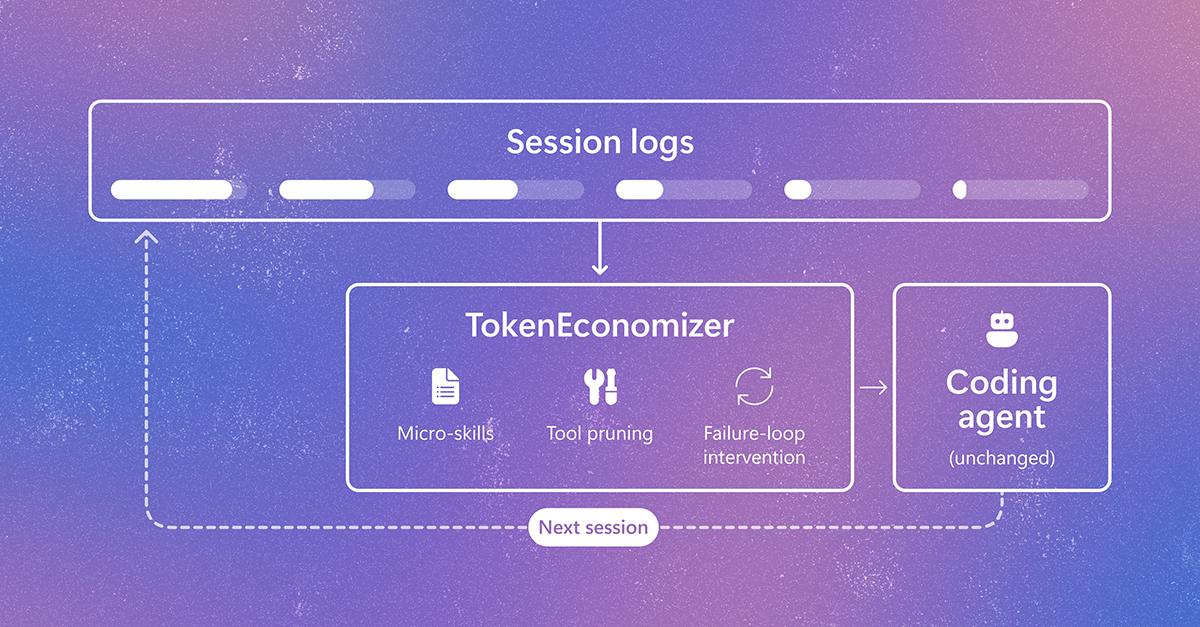
AI coding agents are increasingly help developers fix bugs and build features largely on their own, but every interaction with their models consumes tokens. In each session, an agent sends instructions, tool descriptions, and session history to its model. Most efforts to reduce this cost focus on individual tasks. Yet developers return to the same […] The post TokenEconomizer: Learning from Experience to Make AI Coding Agents More Efficient appeared first on Microsoft Research.
MIT News · Artificial Intelligence· news.mit.eduNov 13, 2026