This paper designs an algorithm that combines denoisers at decreasing noise levels with a schedule tailored to ensure convergence, and proves that it surpasses convergent methods while competing with state-of-the-art empirical ones.
Abstract
Pretrained denoisers provide a powerful way to incorporate image priors into restoration algorithms. Plug-and-Play and RED approaches exploit fixed-noise-level denoisers within first-order optimization schemes, with convergence guarantees, but often struggle to achieve high-quality reconstruction on severely ill-posed inverse problems. In contrast, recent state-of-the-art approaches leverage denoisers derived from flow- or diffusion-based generative models and evaluate them along a sequence of decreasing noise levels. While these methods achieve strong empirical performance, their convergence theory remains limited. In this paper, we bridge this gap by specifically designing an algorithm that combines denoisers at decreasing noise levels with a schedule tailored to ensure convergence. From a Bayesian perspective, we prove that our method converges to a $\textit{Maximum a Posteriori}$ (MAP) estimate, under suitable assumptions. Subsequently, we apply our method to various ill-posed inverse problems and show that it surpasses convergent methods while competing with state-of-the-art empirical ones.

This work establishes convergence guarantees for a broad family of Plug-and-Play algorithms with annealed noise level, spanning deterministic methods (RED and PnP--PGD) and stochastic methods (SNORE, equivariant RED, and a variant of PnP--Flow) and proves asymptotic stationarity of the iterates with respect to this obj...
Plug-and-play (PnP) methods, which embed powerful image denoisers into classical optimization algorithms, have achieved remarkable performance on a variety of imaging inverse problems. However, most existing PnP frameworks impose regularization only in the spatial domain. In many practical settings, measurement noise i...
Wen-Jian Du, Jia Li· IEEE Transactions on Image P...· 0 citations
This paper introduces a posterior sampling algorithm customized for the pyramidal/cascaded architecture, which relies on a coarse to fine hierarchical strategy to generate images in the pixel domain and presents CLIMB-Flow which alternates between three steps: an end-point estimation from the current coarse and noisy i...
Plug-and-Play (PnP) algorithms are a class of iterative methods for inverse imaging. Within an optimization algorithm, they combine a flexible fidelity term, encoding the forward operator, and a pretrained image denoiser, in order to deal with more severe corruptions such as blurring or downsampling when reconstructing...
Zi-Qi Qin, Hong-Wei Tan, A. Biguri et al.· 0 citations
Recovering Partial Differential Equation (PDE) coefficient fields from extremely sparse observations is a severely ill-posed inverse problem for which generative machine learning methods (e.g., diffusion models) have become a leading way to encode the prior. Recent state-of-the-art diffusion solvers lift these priors t...
Yi Pan, Muhammad H. Ashiq, Chan-Yong Jung et al.· 0 citations
Plug-and-Play (PnP) methods replace proximal operators with learned denoisers, which produce state-of-the-art reconstruction quality, but sacrifice the variational interpretation and convergence guarantees of proximal methods. Learned Proximal Networks (LPNs) address this problem by designing the denoiser architecture...
H. Pritchard, Rahul Parhi· 0 citations
Related blog posts
MIT News · Artificial Intelligence· news.mit.eduOct 28, 2026
Professor Paris Smaragdis develops computers with superhuman hearing for applications like speech recognition, music understanding, and environmental monitoring.
Exploring how generative AI could make machine vision more accessible to businesses. The post GenEye in a Box: Making Machine Vision Something You Can Just Ask For appeared first on GPT-Lab.
Microsoft Research Blog· microsoft.comAug 11, 2026
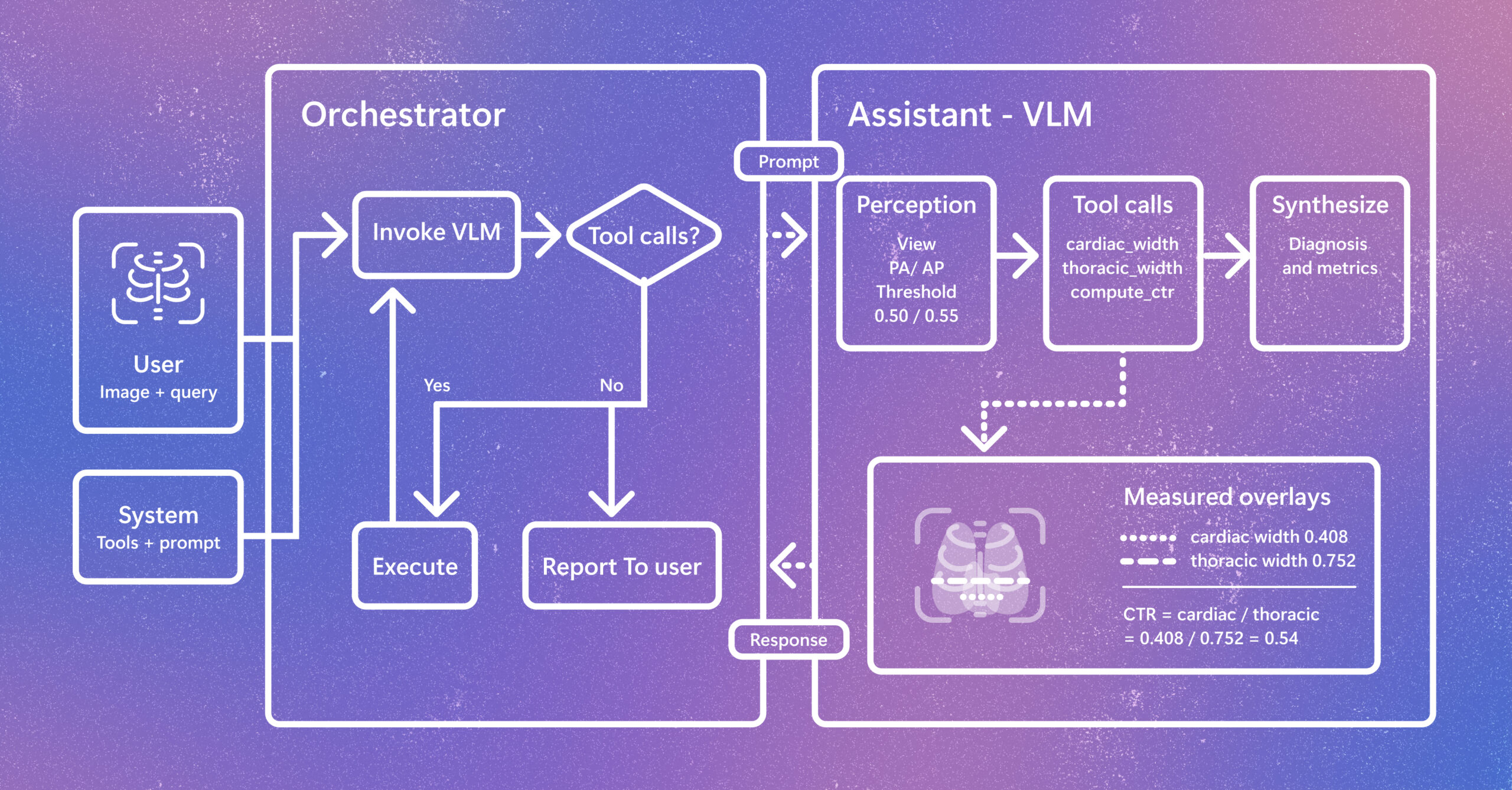
Radiology AI is evolving beyond report generation. CARE-X explores a unified approach that combines flexible reasoning, calibrated predictions, and measurement-based tools for chest X-ray interpretation. The post Introducing CARE-X: Towards Clinically Useful Radiology VLMs with Auxiliary Supervision, Reward-Aligned Learning, and Tool-Augmented Measurement appeared first on Microsoft Research.