MissCNF is introduced, which trains CNFs directly on incomplete data by maximizing the marginal likelihood of each partially observed sample, without discarding rows or constructing a completed dataset, and is compared with two common strategies for handling missing data.
Abstract
Causal Normalizing Flows (CNFs) enable causal inference from observational data given the causal structure, but they assume fully observed training data. We introduce MissCNF, which trains CNFs directly on incomplete data by maximizing the marginal likelihood of each partially observed sample, without discarding rows or constructing a completed dataset. Thanks to the causal structure encoded in the autoregressive factorization of CNFs, only missing variables in the ancestral closure of the observed set are integrated out, while the others are dropped without computation. We further establish the conditions under which MissCNF recovers the true joint distribution, and introduce \emph{causal-family positivity}, where identification is possible even when no record in the dataset is ever complete. We compare MissCNF with two common strategies for handling missing data: listwise deletion and impute-then-fit pipelines. Across eight synthetic causal benchmarks, three missingness mechanisms, and missing rates up to $90\%$, MissCNF achieves the lowest KL divergence in 23 of 24 nonlinear MCAR and MAR settings and in all nonlinear MNAR settings, as well as the lowest counterfactual error in 20 of 24 settings. On linear SCMs, where linear imputation performs best, MissCNF ranks in the top two in 22 of 24 settings.
This paper organizes methods by prediction target, prediction granularity, encoder, structural decoder, and training regime to relate what each method predicts to how it uses data and simulator-based supervision, and distinguishes two questions: whether the target is identifiable under the assumed model class and wheth...
Pingchuan Ma, Rui Ding, Bojun Huang et al.· 0 citations
External causal reports can improve structure learning from limited observations, but their reliability varies across sources and variable pairs. We introduce HB-NoisyKG, a Bayesian framework that combines observational data with repeated causal reports from sources such as large language models. Each report is a noisy...
RCA-DCM improves top-1 accuracy over the strongest baseline on both Sock Shop and Online Boutique, and when the true root cause in the causal chamber is unobserved and acts as a latent confounder, it recovers the exact root-cause set more often than any competing method.
MissPath-FM is proposed, a partial-observation-aware flow matching framework that redesigns the source prior and probability path for incomplete time series and reveals a regime-dependent design hierarchy in which no single component suffices.
SaCRL is introduced, a framework that jointly identifies the causal structure and learns the corresponding invariant representation without prior structural knowledge, and provides theoretical guarantees for structure identification, including under random-feature approximation, invariance satisfaction, and out-of-dist...
Structural causal models for time series recover contemporaneous and lagged effects, but most methods require complete observation windows and become misspecified when samples are missing. We introduce ITSY, the first continuous-optimization method for causal discovery from irregular time series under a linear model. I...
Wen-Bo Xu, Yue He, Yun-Hai Wang et al.· arXiv.org· 0 citations
Related blog posts
Microsoft Research Blog· microsoft.comNov 16, 2026
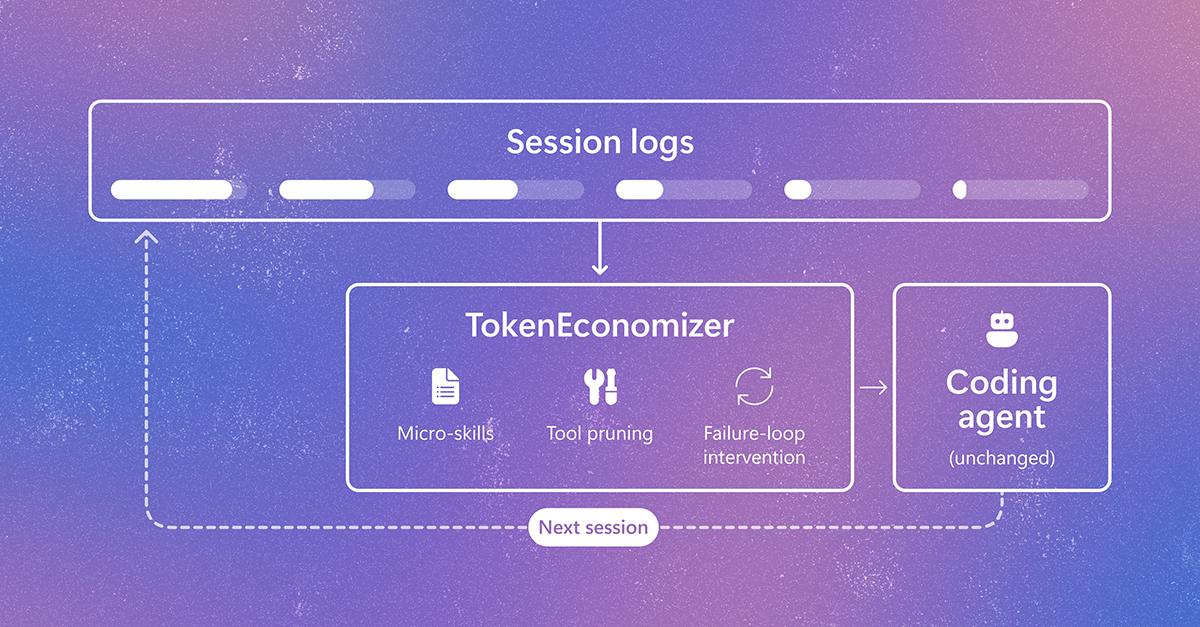
AI coding agents are increasingly help developers fix bugs and build features largely on their own, but every interaction with their models consumes tokens. In each session, an agent sends instructions, tool descriptions, and session history to its model. Most efforts to reduce this cost focus on individual tasks. Yet developers return to the same […] The post TokenEconomizer: Learning from Experience to Make AI Coding Agents More Efficient appeared first on Microsoft Research.
MIT News · Artificial Intelligence· news.mit.eduNov 13, 2026