Skip to content
#machine learning #quantum computing Preprint Open access

Instance-optimal high-precision shadow tomography with few-copy measurements: A metrological approach

Senrui Chen Weiyuan Gong Sisi Zhou
Sep 2026
Machine Learning Quantum Computing

Abstract

We study the sample complexity of shadow tomography in the high-precision regime under realistic measurement constraints. Given an unknown $d$-dimensional quantum state $\rho$ and a known set of observables $\{O_i\}_{i=1}^m$, the goal is to estimate expectation values $\{\mathrm{tr}(O_i\rho)\}_{i=1}^m$ to accuracy $\epsilon$ in $L_p$-norm, using possibly adaptive measurements that act on $O(\mathrm{polylog}(d))$ number of copies of $\rho$ at a time. We focus on the regime where $\epsilon$ is below an instance-dependent threshold. Our main contribution is an instance-optimal characterization of the sample complexity as $\tilde{\Theta}(\Gamma_p/\epsilon^2)$, where $\Gamma_p$ is a function of $\{O_i\}_{i=1}^m$ defined via an optimization formula involving the inverse Fisher information matrix. Previously, tight bounds were known only in special cases, e.g. Pauli shadow tomography with $L_\infty$-norm error. Concretely, we first analyze a simpler oblivious variant where the goal is to estimate an observable of the form $\sum_{i=1}^m \alpha_i O_i$ with $\|\alpha\|_q = 1$ (where $q$ is dual to $p$) revealed after the measurement. For single-copy measurements, we obtain a sample complexity of $\Theta(\Gamma^{\mathrm{ob}}_p/\epsilon^2)$. We then show $\tilde{\Theta}(\Gamma_p/\epsilon^2)$ is necessary and sufficient for the original problem, with the lower bound applying to unbiased, bounded estimators. Our upper bounds rely on a two-step algorithm combining coarse tomography with local estimation. Notably, $\Gamma^{\mathrm{ob}}_\infty = \Gamma_\infty$. In both cases, allowing $c$-copy measurements improves the sample complexity by at most $\Omega(1/c)$. Our results establish a quantitative correspondence between quantum learning and metrology, unifying asymptotic metrological limits with finite-sample learning guarantees.

View source

Similar papers

#computer vision Review Sep 2017

Agile Software Development Methods: Review and Analysis

This publication proposes a definition and a classification of agile software development approaches and analyses ten software development methods that can be characterized as being "agile" against the defined criterion.

P. Abrahamsson, O. Salo, Jussi Ronkainen et al. · 727 citations · ⚡54
#computer vision Jun 2008

The impact of agile practices on communication in software development

The study shows that agile practices improve both informal and formal communication, but indicates that, in larger development situations involving multiple external stakeholders, a mismatch of adequate communication mechanisms can sometimes even hinder the communication.

M. Pikkarainen, Jukka Haikara, O. Salo et al. · 401 citations · ⚡48
#machine learning Review Open access Oct 2014

Software development in startup companies: A systematic mapping study

The results indicate that software engineering work practices are chosen opportunistically, adapted and configured to provide value under the constrains imposed by the startup context.

Nicolò Paternoster, Carmine Giardino, M. Unterkalmsteiner et al. · 394 citations · ⚡54

Diffusion models as plug-and-play priors

The possibility of inferring high-dimensional data inference in a model that consists of a prior and an auxiliary differentiable constraint given some additional information is considered, thereby allowing a range of potential applications in adapting models to new domains and tasks.

Alexandros Graikos, Esmeralda S. Whitammer, N. Jojic et al. · 316 citations · ⚡15

Related blog posts

MIT News · Artificial Intelligence Aug 27, 2026

Looking beyond natural sequences

A new machine-learning framework aims to improve the success rate of computational protein design while moving away from results that reproduce sequences found in nature.

Microsoft Research Blog Aug 20, 2026

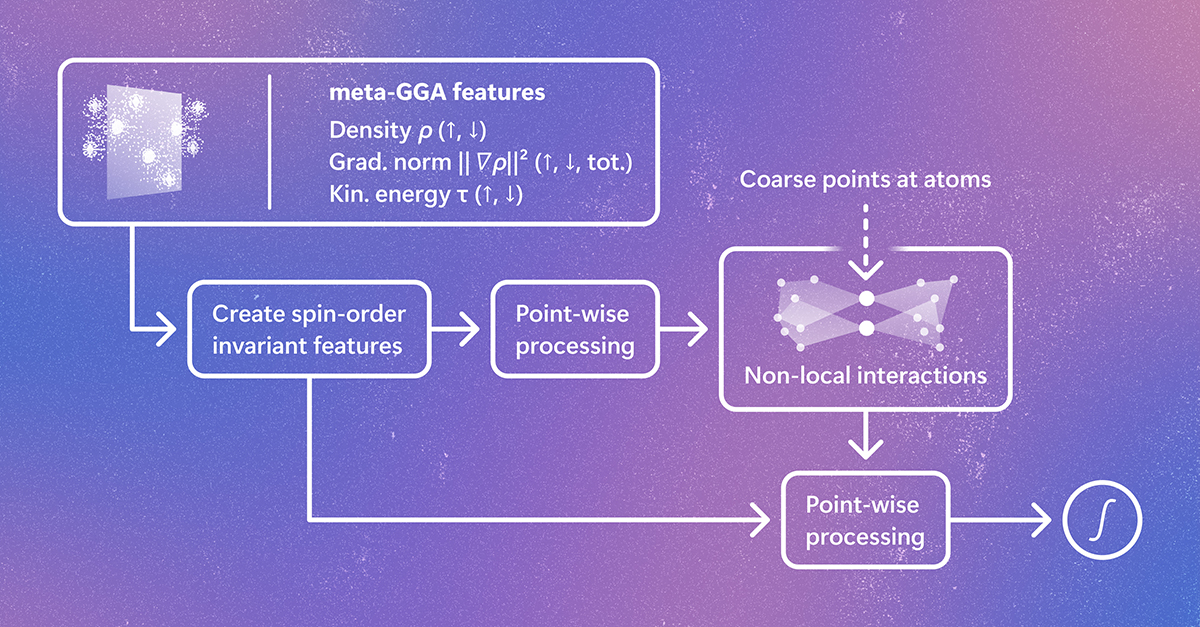
Broadening access to Skala creates a faster path to predictive DFT 

Skala 1.1, the updated deep-learning exchange-correlation functional from Microsoft Research, provides greater accuracy, expanded accessibility across the computational chemistry ecosystem, and a living benchmark to track computational performance. The post Broadening access to Skala creates a faster path to predictive DFT  appeared first on Microsoft Research.

We use cookies to run the site and, with your consent, for analytics and to show ads. See our Cookie Policy.