Vision-language models (VLMs) can answer simple visual questions, but often struggle when one question requires several visual judgments. We study this gap with controlled tasks for feature binding, numerosity, spatial relations, and amodal completion, together with a Composite task that combines them. Matched counterfactual image pairs isolate changes in the visual evidence needed to answer. Across four models, direct answers, hidden-state readouts, and state interventions show that the individual judgments can be made without explicit reasoning and that intervening on the corresponding states can affect the answer. During reasoning, the Composite answer becomes decodable from hidden states and usable from shortened traces, often before the model stops on its own. We train a small detector to predict this readiness and stop reasoning at that point. On MMStar and RealWorldQA, this reduces mean reasoning tokens by 79.1% and 74.5%, while average accuracy rises by 3.13 and 3.30 percentage points, respectively. These findings connect the internal development of answer readiness to a practical rule for allocating reasoning computation.
This publication proposes a definition and a classification of agile software development approaches and analyses ten software development methods that can be characterized as being "agile" against the defined criterion.
P. Abrahamsson, O. Salo, Jussi Ronkainen et al.· arXiv.org· 727 citations· ⚡54
The study shows that agile practices improve both informal and formal communication, but indicates that, in larger development situations involving multiple external stakeholders, a mismatch of adequate communication mechanisms can sometimes even hinder the communication.
M. Pikkarainen, Jukka Haikara, O. Salo et al.· Empirical Software Engineeri...· 401 citations· ⚡48
The results indicate that software engineering work practices are chosen opportunistically, adapted and configured to provide value under the constrains imposed by the startup context.
Nicolò Paternoster, Carmine Giardino, M. Unterkalmsteiner et al.· Information and Software Tec...· 394 citations· ⚡54
The possibility of inferring high-dimensional data inference in a model that consists of a prior and an auxiliary differentiable constraint given some additional information is considered, thereby allowing a range of potential applications in adapting models to new domains and tasks.
Alexandros Graikos, Esmeralda S. Whitammer, N. Jojic et al.· Neural Information Processin...· 316 citations· ⚡15
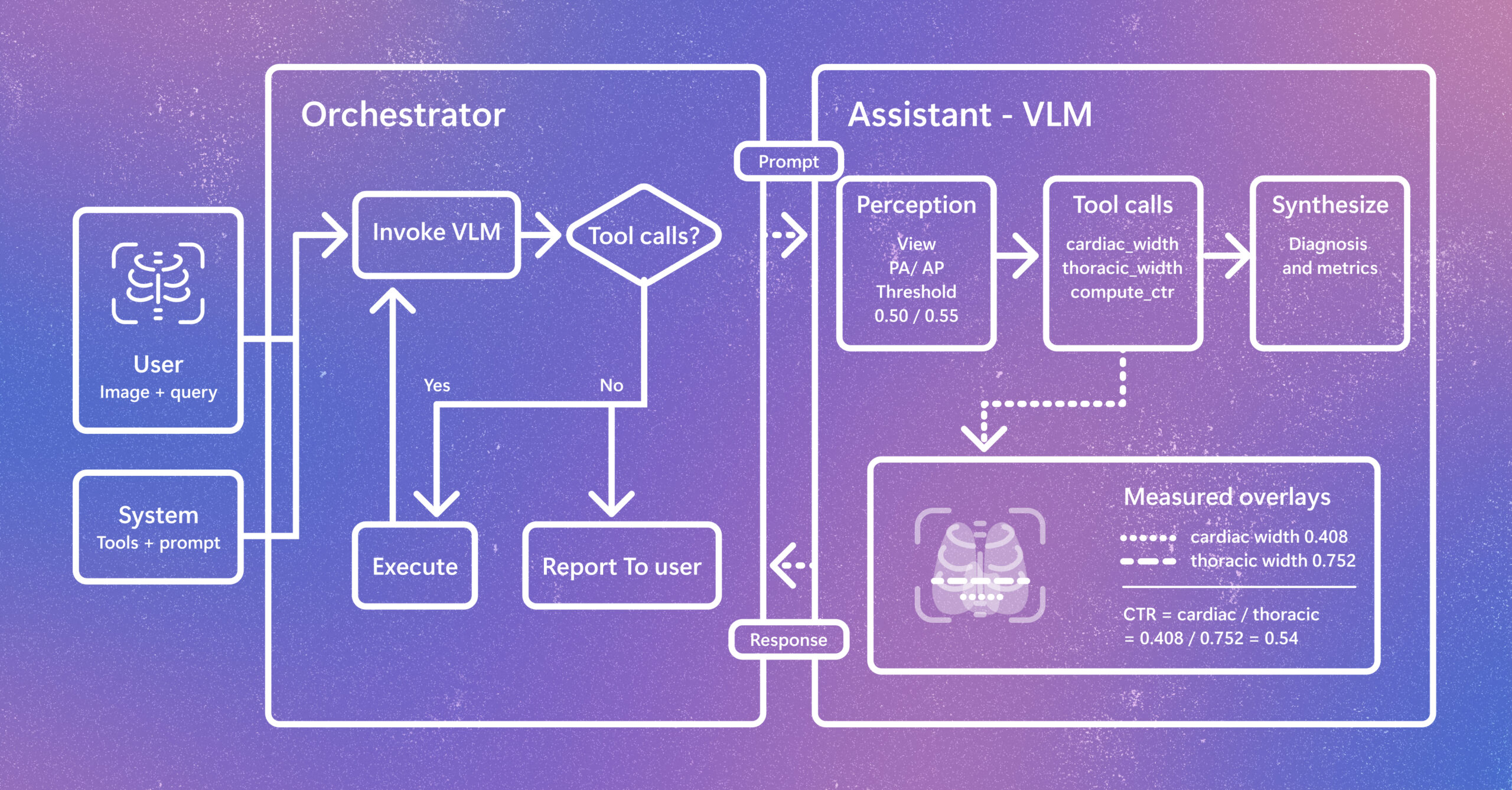
Radiology AI is evolving beyond report generation. CARE-X explores a unified approach that combines flexible reasoning, calibrated predictions, and measurement-based tools for chest X-ray interpretation. The post Introducing CARE-X: Towards Clinically Useful Radiology VLMs with Auxiliary Supervision, Reward-Aligned Learning, and Tool-Augmented Measurement appeared first on Microsoft Research.
