Constrained Edit Fields (CEF) achieves state-of-the-art Structure Distance, background LPIPS, and background MSE with both Stable Diffusion 3.5 Medium and FLUX, while retaining competitive instruction alignment.
Abstract
Text-guided image editing aims to perform a desired edit while preserving source content unrelated to it. Pretrained rectified-flow models enable training-free editing of real images through modifications to their sampling trajectories. However, responses at locations unrelated to the desired edit can still accumulate along the editing trajectory and become visible in the final result. To overcome this, we propose Constrained Edit Fields (CEF), which assigns each spatial location a continuous edit responsibility that quantifies its relevance to the desired edit. CEF estimates edit responsibility directly from the source image when the relevant content is present. For edits whose target content is absent from the source, CEF first generates an unconstrained proposal to reveal its realized spatial support and then estimates responsibility from that proposal. At each editing step, CEF decomposes the base edit field into prompt-induced and trajectory-induced components, enabling edit responsibility to preserve instruction-relevant updates while suppressing unintended trajectory-induced changes. Evaluated on all 700 PIE-Bench examples, CEF achieves state-of-the-art Structure Distance, background LPIPS, and background MSE with both Stable Diffusion 3.5 Medium and FLUX, while retaining competitive instruction alignment. On Stable Diffusion 3.5 Medium, it reduces these metrics over the previous best results by 10.2%, 21.2%, and 48.0%, respectively.
Text-guided image editing using rectified flow models such as Multimodal Diffusion Transformer (DiT) has demonstrated impressive generation quality. However, existing methods apply edits globally, inevitably modifying background regions unrelated to the intended semantic change. Our key observation is that the Text-to-...
Trong-Tai Dam Vu, Vinh-Tiep Nguyen· International Conference on...· 0 citations
SR-Edit is proposed, an image editing framework that overcomes issues via iterative self-refinement and achieves superior preservation and overall image quality compared to existing editing techniques.
Andong Wang, Zehua Chen, Yuxuan Jiang et al.· 0 citations
Text-guided video editing modifies target content while preserving the appearance and temporal coherence of unedited regions. Training-based approaches provide strong control but demand substantial data and computation. Training-free methods fall into inversion-free and inversion-based paradigms. Inversion-free approac...
Chong-Bo Zhao, Jiangming Wang, Xilai Wang et al.· 0 citations
Text-guided image editing must introduce the requested changes while preserving unrelated source content. In training-free editing, diffusion editors often use spatial controls whose inaccuracies can leave edits incomplete or alter unrelated regions. Causal autoregressive editors face a further constraint: their fixed...
Yu-Long Chen, Zi-Qian Zhang, Hao-Yu Zhang et al.· 0 citations
Video object removal presents a uniquely difficult editing challenge. Because a removal prompt specifies only what to erase rather than what to generate, the model must infer and reconstruct a highly specific occluded background entirely from the surrounding context. Existing training-free methods struggle with this be...
Song-He Wang, Li-Fu Wei, Shuo-Lin Xu et al.· 0 citations
Image editing should change only the attributes specified by an instruction while preserving everything else, yet current methods often make unintended changes. We treat this minimal-change principle as an optimization objective for instruction-based editing. Latent L1 regularization is a poor proxy for output locality...
Shuo Chen, Feng-Ming Huang, Yu Yao et al.· 0 citations
Exploring how generative AI could make machine vision more accessible to businesses. The post GenEye in a Box: Making Machine Vision Something You Can Just Ask For appeared first on GPT-Lab.
Microsoft Research Blog· microsoft.comAug 11, 2026
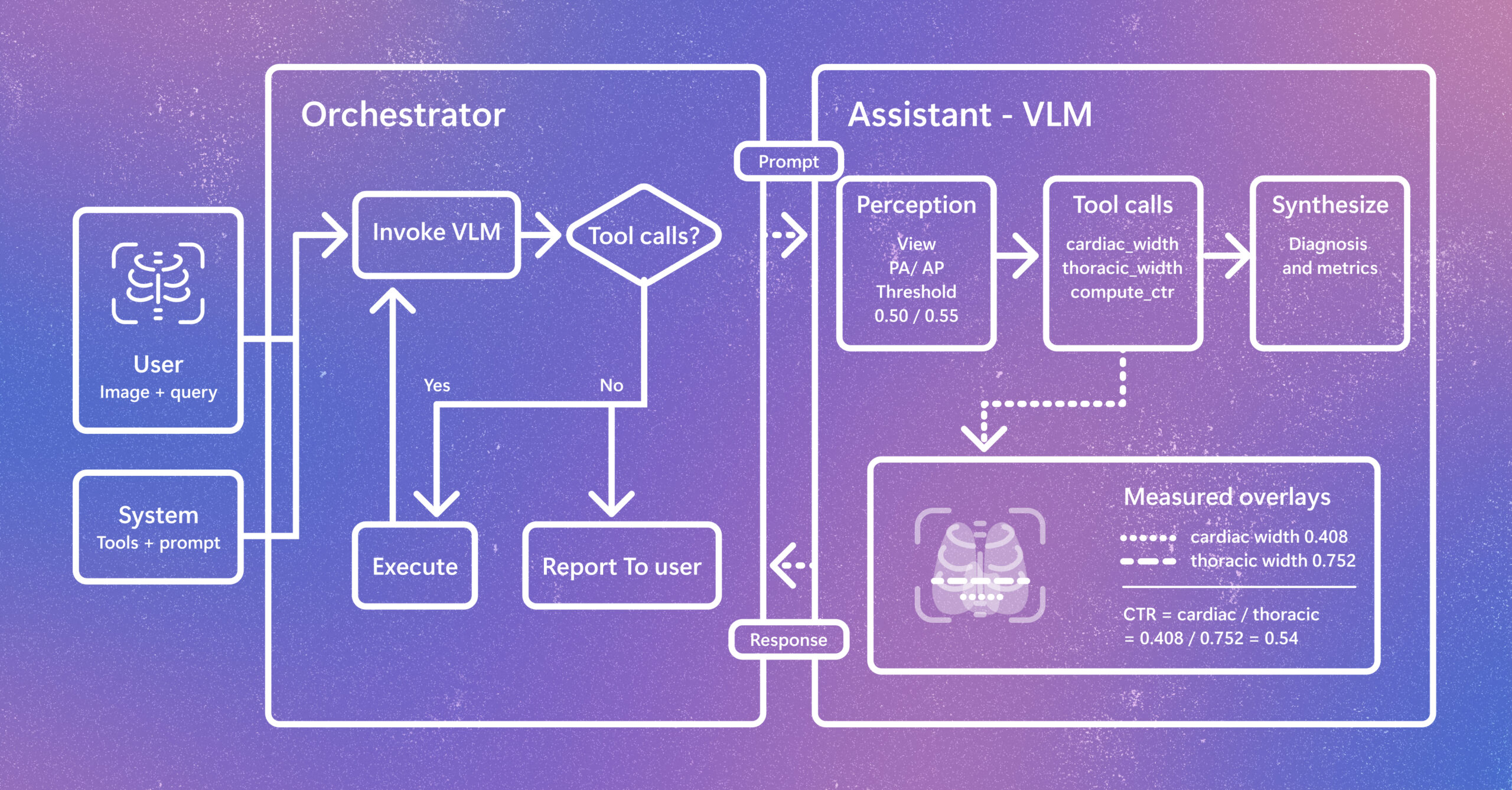
Radiology AI is evolving beyond report generation. CARE-X explores a unified approach that combines flexible reasoning, calibrated predictions, and measurement-based tools for chest X-ray interpretation. The post Introducing CARE-X: Towards Clinically Useful Radiology VLMs with Auxiliary Supervision, Reward-Aligned Learning, and Tool-Augmented Measurement appeared first on Microsoft Research.
Students in MIT’s Concourse program delve deeply into the human condition, debate challenging questions, and learn to develop judgment about issues that can’t be quantified.
We use cookies to run the site and, with your consent, for analytics and to show ads.
See our Cookie Policy.