Practical assistive and rehabilitative brain--computer interfaces require subject-independent motor-imagery EEG (MI-EEG) decoders that generalize to new users under limited target-user data and constrained compute. However, held-out-subject performance can be overstated when test-subject information influences preprocessing, model selection, or ensemble selection. We present \textit{ThinkNet}, a validation-controlled framework that combines train-only normalization, validation-guided evolutionary search, and validation-gated inference to identify compact decoders and inference policies for held-out subjects. We evaluate four-class BCI Competition IV-2a (session T) decoding with nine Leave-One-Subject-Out (LOSO) folds, three seeds, seven fixed decoder entries, and a broader search over ten representative decoder families; the held-out subject is never used for normalization, hyperparameter, architecture, or ensemble-policy selection. In the fixed benchmark, the validation-selected compact decoder achieved 44.35$\pm$15.41\% accuracy with 4.9K parameters, 19 KB FP32 weights, and 0.99 ms batch-1 Orin CUDA inference. Across the broader search, compact models ($\leq$25K parameters) achieved higher mean held-out accuracy than mid-size and large alternatives after selected retraining (40.10\% vs. 35.09\% and 34.78\%). Validation-gated ensembling improved over validation-selected single-model inference, reaching 43.98$\pm$16.25\% in the fixed benchmark and 43.31$\pm$15.88\% for the compact six-family ensemble. A non-deployable oracle analysis revealed a 6.1-point family-selection gap and near-zero validation--test correlation, showing that validation reliability remains a key bottleneck under subject shift. Thus, ThinkNet is a validation-controlled framework for compact MI-EEG model and inference-policy selection, rather than a single-architecture benchmark.

It is found that Llama 3 delivers comparable quality to leading language models such as GPT-4 on a plethora of tasks, and performs competitively with the state-of-the-art on image, video, and speech recognition tasks.
This paper investigates developing real-world perception for active agents, proposes Gibson Environment for this purpose, and showcases a set of perceptual tasks learned therein.
F. Xia, Amir Zamir, Zhi-Yang He et al.· 2018 IEEE/CVF Conference on...· 1,069 citations· ⚡112
This publication proposes a definition and a classification of agile software development approaches and analyses ten software development methods that can be characterized as being "agile" against the defined criterion.
P. Abrahamsson, O. Salo, Jussi Ronkainen et al.· arXiv.org· 727 citations· ⚡54
The study shows that agile practices improve both informal and formal communication, but indicates that, in larger development situations involving multiple external stakeholders, a mismatch of adequate communication mechanisms can sometimes even hinder the communication.
M. Pikkarainen, Jukka Haikara, O. Salo et al.· Empirical Software Engineeri...· 401 citations· ⚡48
The results indicate that software engineering work practices are chosen opportunistically, adapted and configured to provide value under the constrains imposed by the startup context.
Nicolò Paternoster, Carmine Giardino, M. Unterkalmsteiner et al.· Information and Software Tec...· 394 citations· ⚡54
By studying the computational foundations of language learning, Associate Professor Jacob Andreas builds intelligent systems that can communicate effectively with humans.
Microsoft Research Blog· microsoft.comNov 16, 2026
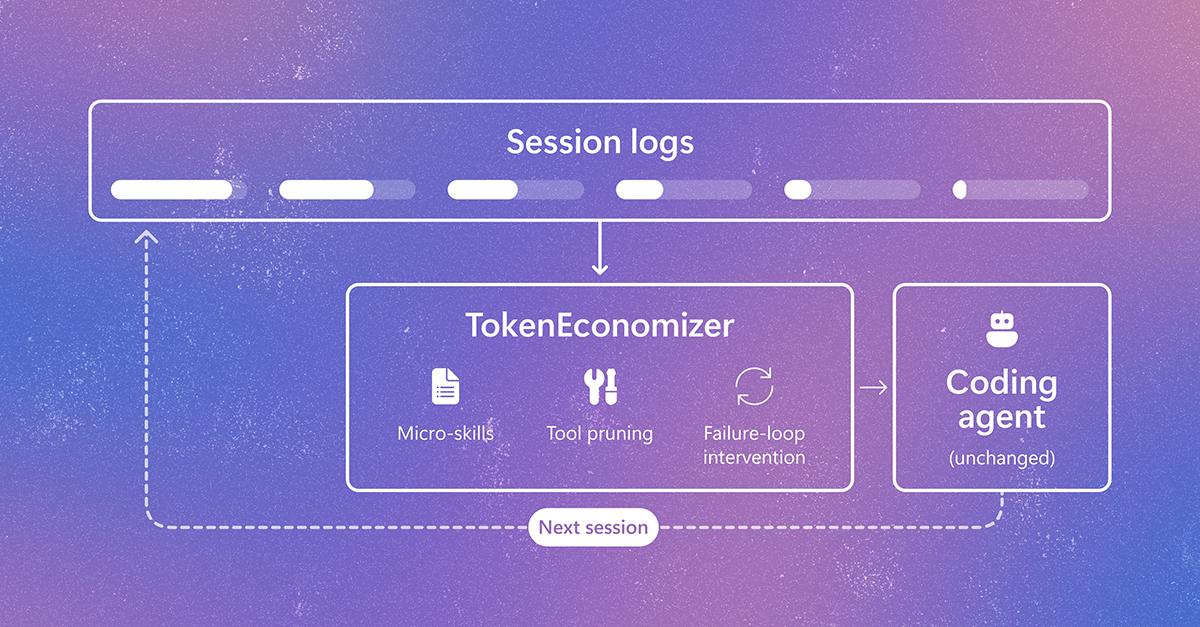
AI coding agents are increasingly help developers fix bugs and build features largely on their own, but every interaction with their models consumes tokens. In each session, an agent sends instructions, tool descriptions, and session history to its model. Most efforts to reduce this cost focus on individual tasks. Yet developers return to the same […] The post TokenEconomizer: Learning from Experience to Make AI Coding Agents More Efficient appeared first on Microsoft Research.
MIT News · Artificial Intelligence· news.mit.eduNov 13, 2026