A hierarchical causal representation learning framework applied to sea surface temperature fields from a state-of-the-art global climate model is developed that accurately predicts the long-term global mean and regional temperature evolution and shows physically realistic responses to perturbations in greenhouse gas and aerosol concentrations when evaluated on unseen scenarios.
Abstract
Machine learning (ML) emulators provide a fast and cost-effective method to simulate climate change scenarios after being trained on Earth System Models projections. However, the black-box nature of those data-driven approaches limit the usability and trustworthiness of their outputs and in particular their use as causal attribution tools. Here, we develop a hierarchical causal representation learning framework applied to sea surface temperature fields from a state-of-the-art global climate model. As a key advance over previous work, our framework explicitly models both atmospheric dynamical interactions arising from internal climate variability and forced responses due to changes in atmospheric greenhouse gas and aerosol concentrations. When trained on future climate change scenarios, our method accurately predicts the long-term global mean and regional temperature evolution and shows physically realistic responses to perturbations in greenhouse gas and aerosol concentrations when evaluated on unseen scenarios. Our results underline the potential of causal representation learning frameworks for advancing climate model emulation.
GCMagicc is a hybrid model that pairs a simple physical climate model with machine learning to generate ensembles of 10 climate variables at the resolution of full-scale Earth system models, without relying on GPU resources or retraining for new scenarios.
N. Meinshausen, M. Meinshausen, J. Lewis et al.· 1 citation
Effective climate risk assessment is hindered by the resolution gap between coarse global climate models and the fine-scale information needed for regional decision making. Existing downscaling methods struggle to bridge this gap: physics-based methods are too computationally expensive for large ensemble sampling of...
Zhong-Yi Wan, I. Lopez-Gomez, Rob Carver et al.· Nature Machine Intelligence· 0 citations
A Koppen-Geiger climate-zone decomposition is applied to AIMIP Phase 1 models under prescribed +4K SST forcing and their responses to physics-based AMIP models are compared, comparing baseline classification skill, per-zone responses in temperature, precipitation, and near-surface specific humidity, and the spatial str...
Charlotte Merchant, Milan Klöwer, Bradley Stanley-Clamp et al.· 1 citation· ⚡1
Long-term climate data exhibit variations composed of internal and forced components. Internal variability arises from natural processes that could occur within a stable climate. Forced variability, on the other hand, reflects climate changes induced, for example, by anthropogenic greenhouse gas and aerosol emissions....
G. Gastineau, E. Provenzano, Constantin Bône et al.· 0 citations
This Review compares land surface, Earth system, statistical, and machine learning model approaches that are used to project future fire activity across global and regional scales under multiple climate scenarios to show that different modelling approaches provide complementary strengths for distinct applications.
Cynthia H. Whaley, Yang Li, Isabelle Valiquette et al.· Communications Earth & Envir...· 0 citations
Related blog posts
Microsoft Research Blog· microsoft.comNov 16, 2026
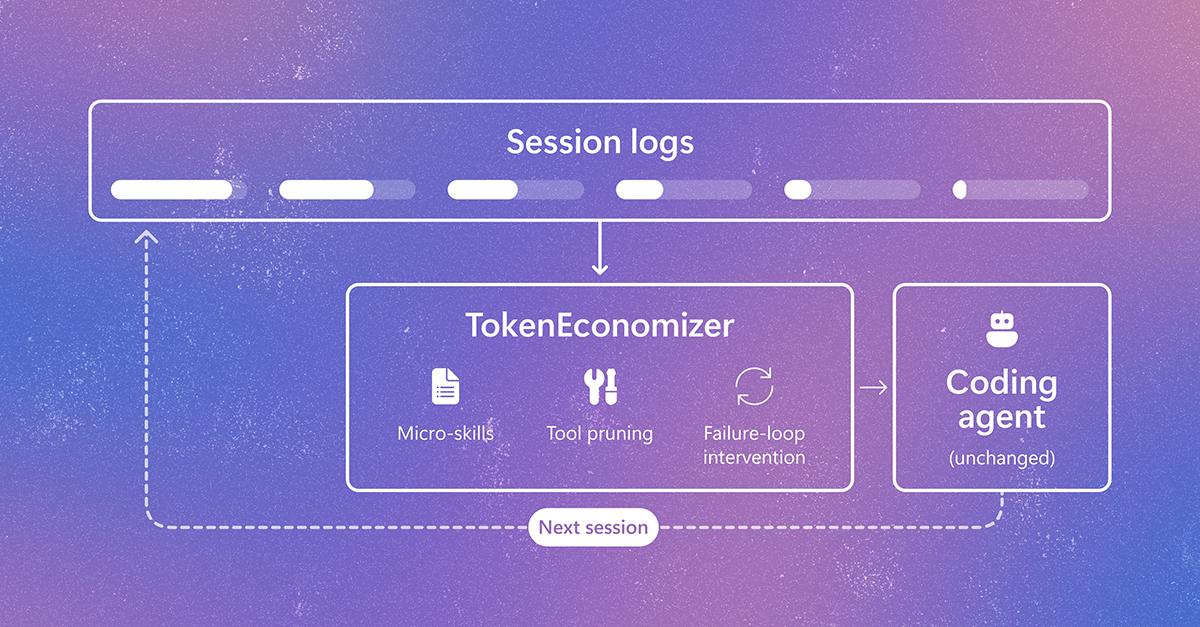
AI coding agents are increasingly help developers fix bugs and build features largely on their own, but every interaction with their models consumes tokens. In each session, an agent sends instructions, tool descriptions, and session history to its model. Most efforts to reduce this cost focus on individual tasks. Yet developers return to the same […] The post TokenEconomizer: Learning from Experience to Make AI Coding Agents More Efficient appeared first on Microsoft Research.
MIT News · Artificial Intelligence· news.mit.eduNov 13, 2026