Higher bounds of adversarial robustness are proved for every concept class of $\operatorname{VC}$ of $\operatorname{VC}$ dimension $d$ in the realizable and agnostic settings and an optimal first-order refinement of the latter, together with an optimal first-order refinement of the latter.
Abstract
We study the problem of \emph{adversarially robust} PAC learning. In this framework, the learner observes independent samples from an unknown distribution over $\mathcal{X} \times \{0,1\}$, as in classical PAC learning. However, given a perturbation map $\mathcal{U} : \mathcal{X} \to 2^{\mathcal{X}}$ known to the learner, the goal is to output, with high probability, a predictor that correctly classifies \emph{every} perturbation $z \in \mathcal{U}(x)$ of most future examples $(x,y)$ drawn from the same underlying distribution. We determine the \emph{optimal} $\mathcal{U}$-independent sample complexity of this problem in both the realizable and agnostic settings. More specifically, for every concept class $\mathcal{H}$ of $\operatorname{VC}$ dimension $d$, we prove upper bounds of $\mathcal{O} \big( d/\epsilon + \log(1/\delta)/\epsilon \big)$ in the realizable setting and $\mathcal{O} \big( d/\epsilon^2 + \log(1/\delta)/\epsilon^2 \big)$ in the agnostic setting, together with an optimal first-order refinement of the latter. These bounds match the corresponding lower bounds for classical PAC learning. Consequently, and perhaps surprisingly, adversarial robustness incurs \emph{no additional} distribution-free statistical cost, uniformly over all perturbation maps. Our bounds improve exponentially on those of [Montasser, Hanneke, and Srebro; COLT'19]. On the technical side, we present short and elementary proofs based on a new algorithmic principle that we call \emph{binomial-bagging}. We believe that binomial-bagging and its analysis may be of independent interest.
Building on a probabilistic perspective in which adversarial examples arise from the overlap between a distance-based distribution $p_{\mathrm{dis}}$ and a victim-classifier-induced distribution $p_{\mathrm{vic}}$, we start from a simple intuition: adversarial examples become harder to generate when these two distribut...
It is shown that a simple Follow-the-Perturbed-Leader algorithm with Gaussian perturbation for each observed context achieves the optimal $\widetilde O(\sqrt{T\log N})$ expected regret for a class of $N$ experts, while requiring one optimization-oracle call per round and no explicit enumeration of the class.
G. Buzaglo, Elad Hazan· arXiv.org· 7 citations· ⚡1
We study episodic adversarial linear constrained Markov decision processes (CMDPs) with unknown transitions, where both the loss and constraint functions may vary adversarially across episodes. The best previous algorithm achieves $\widetilde{\mathcal{O}}(K^{3/4})$ regret and cumulative constraint violation, leaving a...
A matching lower bound for the class of linear predictors is established and a challenging sequential covariate distribution supported on mutually orthogonal hyperplanes is constructed in explicitly constructing a challenging sequential covariate distribution.
A random preview can replace worst-case sequential complexity by classical statistical dimensions without randomizing the online order by using an online analogue of chaining, implemented as a multiscale aggregation algorithm rather than only as an analytic argument.
We obtain a near-minimax rate on covariance estimation of adversarially corrupted Gaussian data in Frobenius norm when the covariance estimation is assumed to lie in a star-shaped set $K \subseteq \mathbb{R}^{n \times n}$. Assuming a known upper bound of $\varepsilon<1/32$ on the fraction of the $N$ observations of dat...
Samuel Ozminkowski, Hong Jiang, Matey Neykov· 0 citations
Related blog posts
MIT News · Artificial Intelligence· news.mit.eduNov 6, 2026
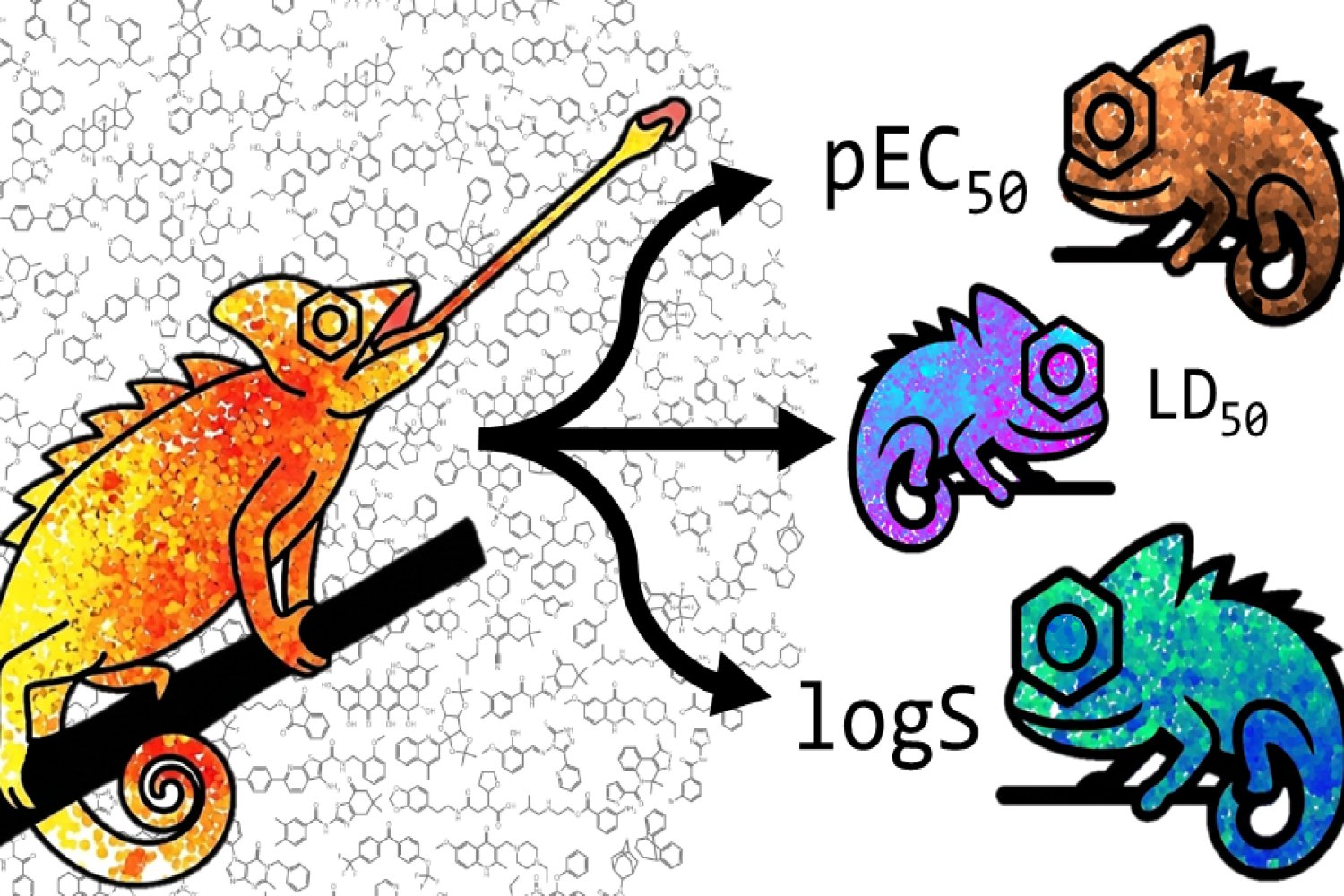
A machine-learning approach called CheMeleon provides a practical way to develop new drugs or other molecules with much less detailed, expensive experimentation.
Learn how Google DeepMind and GovTech Singapore uses lightweight on-device Gemma models to intercept conversational scams in private chats with zero cloud data egress.