This work proposes MUSE, a dependency-aware adaptation framework built on a fully frozen pretrained MAE, which performs lightweight refinement at different encoder depths and explicitly models across-period temporal dependencies and within-period periodic dependencies.
Abstract
Multivariate time-series forecasting is essential to many real-world applications. Recent large vision models (LVMs) offer a promising paradigm by transferring cross-domain visual priors to time-series forecasting. However, existing LVM-based methods face two key challenges: balancing independent visual representation spaces with cross-variable dependency modeling, and adapting vision backbones pretrained on natural images to the distinct temporal semantics of time-series images. To address these challenges, we propose MUSE, a dependency-aware adaptation framework built on a fully frozen pretrained MAE. First, the Variable Context Refinement Module (VCR) aggregates shared temporal information within each variable and models cross-variable contextual dependencies while preserving independent visual spaces. Second, the Temporal-Periodic Refinement Module (TPR) performs lightweight refinement at different encoder depths and explicitly models across-period temporal dependencies and within-period periodic dependencies. The two modules independently produce forecasts, which are fused through a learnable prediction-level gate. Experiments on 10 real-world datasets demonstrate that MUSE achieves state-of-the-art performance.
SMArT enriches intrapatch semantics through self-supervised multiview fusion, and establishes an effective framework for TSF by integrating self-driven multiview learning with LLMs' reasoning power.
Wen-Bin Xing, Meng-Ran Li, Bo-Yuan Zhang et al.· IEEE Transactions on Neural...· 0 citations
This work proposes SAGE (Seeing and Augmenting with Grounded Encoding), an end-to-end CLIP-based framework that jointly models temporal, cross-variable, textual, and visual information and achieves state-of-the-art accuracy.
Time series foundation models (TSFMs) have recently delivered impressive zero-shot performance across diverse forecasting tasks. However, real-world decision-making frequently relies on \emph{irregular multivariate time series} (IMTS), where inconsistent inter-observation intervals and asynchronous sampling across vari...
We introduce Timer-M1, a pretrained multivariate time series foundation model that learns with primitives for zero-shot forecasting. Across domains, time series share elementary temporal and relational patterns, termed primitives, yet differ in how these primitives manifest and evolve across different contexts. Despite...
Hao-Ran Zhang, Hai-Xuan Liu, Xin Su et al.· 0 citations
Related blog posts
Microsoft Research Blog· microsoft.comNov 16, 2026
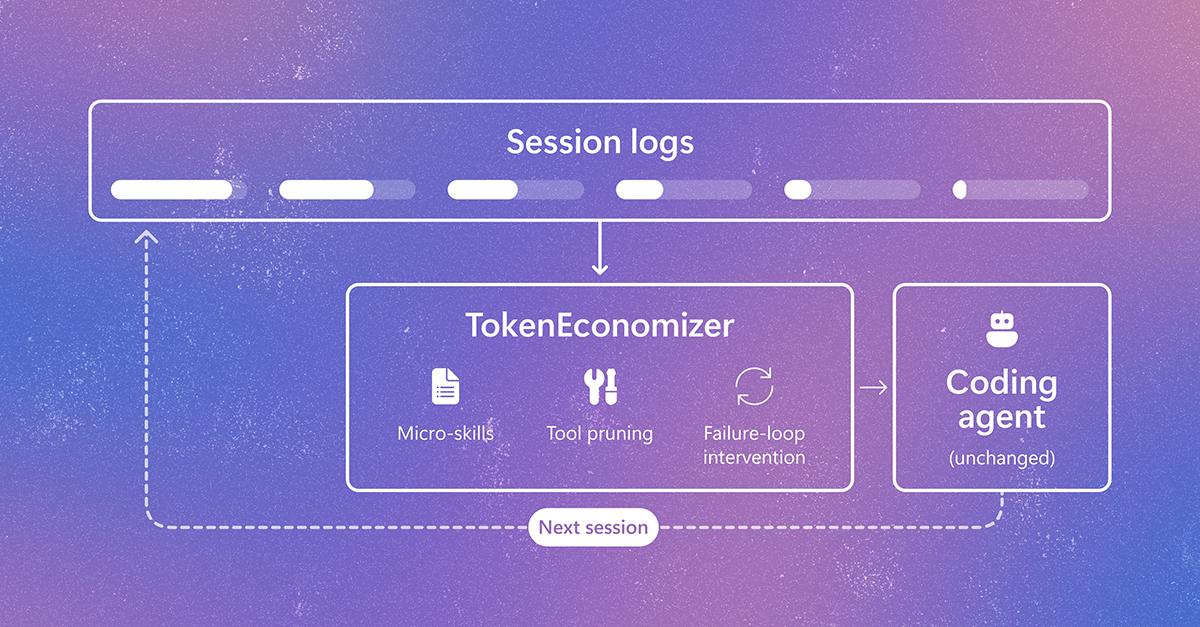
AI coding agents are increasingly help developers fix bugs and build features largely on their own, but every interaction with their models consumes tokens. In each session, an agent sends instructions, tool descriptions, and session history to its model. Most efforts to reduce this cost focus on individual tasks. Yet developers return to the same […] The post TokenEconomizer: Learning from Experience to Make AI Coding Agents More Efficient appeared first on Microsoft Research.
MIT News · Artificial Intelligence· news.mit.eduNov 13, 2026