Skip to content

Rank Portability Does Not Imply Feasibility Portability: Target-Specific Evaluation of Joint Hardware Constraints

Aug 2026 · 0 citations · 13 references
Computer Science

Abstract

Cross-device hardware evaluation often assumes that if architecture rankings transfer across devices, a proxy device can support target-side model selection. We stress-test this assumption for joint latency-energy feasibility across two public architecture families. On NAS-Bench-201, cross-device rank correlations are moderate, while target-comparable feasible-set overlap remains incomplete. A faithful AdaProxy diagnostic substantially improves latency ranking, showing that the observed boundary failures are not simply due to weak adaptation. Exact finite-sample split-conformal analysis also exposes an evidence bottleneck: a finite one-sided 90% threshold requires at least nine calibration observations. We then replicate the phenomenon on 10,000 GPT architectures across 13 HW-GPT-Bench devices. Relative to an RTX3080 proxy, target latency SRCC ranges from 0.951 to 0.996, yet proxy-reuse violation risk ranges from 33.3% to 100% under matched joint constraints. These results show that rank portability, feasibility portability, and target-specific decision support are distinct evaluation objects. Cross-device evaluations should therefore report which target environments actually support the operating point being claimed.

View source

Similar papers

#artificial intelligence Preprint Jul 2024

The Llama 3 Herd of Models

It is found that Llama 3 delivers comparable quality to leading language models such as GPT-4 on a plethora of tasks, and performs competitively with the state-of-the-art on image, video, and speech recognition tasks.

Aaron Grattafiori, Abhimanyu Dubey, Abhinav Jauhri et al. · 21,082 citations · ⚡3,832
#artificial intelligence Conference Open access Jun 2018

Gibson Env: Real-World Perception for Embodied Agents

This paper investigates developing real-world perception for active agents, proposes Gibson Environment for this purpose, and showcases a set of perceptual tasks learned therein.

F. Xia, Amir Zamir, Zhi-Yang He et al. · 1,069 citations · ⚡112
#machine learning Review Open access Oct 2014

Software development in startup companies: A systematic mapping study

The results indicate that software engineering work practices are chosen opportunistically, adapted and configured to provide value under the constrains imposed by the startup context.

Nicolò Paternoster, Carmine Giardino, M. Unterkalmsteiner et al. · 394 citations · ⚡54

Diffusion models as plug-and-play priors

The possibility of inferring high-dimensional data inference in a model that consists of a prior and an auxiliary differentiable constraint given some additional information is considered, thereby allowing a range of potential applications in adapting models to new domains and tasks.

Alexandros Graikos, Esmeralda S. Whitammer, N. Jojic et al. · 316 citations · ⚡15

Trajectory Balance: Improved Credit Assignment in GFlowNets

It is proved that any global minimizer of the trajectory balance objective can define a policy that samples exactly from the target distribution, and empirically demonstrate the benefits of the trajectories balance objective for GFlowNet convergence, diversity of generated samples, and robustness to long action sequenc...

Esmeralda S. Whitammer, Moksh Jain, Emmanuel Bengio et al. · 302 citations · ⚡60

Related blog posts

Microsoft Research Blog Nov 16, 2026

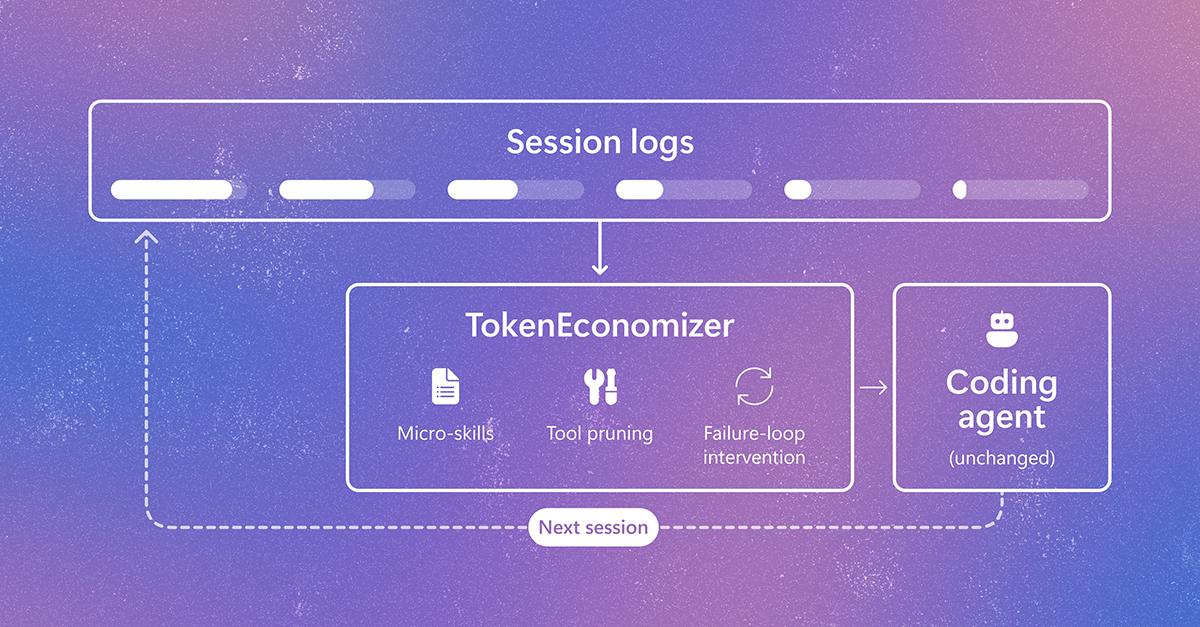
TokenEconomizer: Learning from Experience to Make AI Coding Agents More Efficient

AI coding agents are increasingly help developers fix bugs and build features largely on their own, but every interaction with their models consumes tokens. In each session, an agent sends instructions, tool descriptions, and session history to its model. Most efforts to reduce this cost focus on individual tasks. Yet developers return to the same […] The post TokenEconomizer: Learning from Experience to Make AI Coding Agents More Efficient appeared first on Microsoft Research.

We use cookies to run the site and, with your consent, for analytics and to show ads. See our Cookie Policy.