We prove the first quantum--classical separation for a sampling problem over a continuous domain. For a class of Gibbs states $p\propto e^{-\beta E}$ on the torus $\mathbb{T}^d$ with smooth ($s$-Gevrey) potential and barrier amplitude $\alpha=e^{\beta\Delta}$, where $\Delta = \max E-\min E$, every classical algorithm---querying the value, gradient, or any higher-order derivatives of the log-density---requires $\Omega(\alpha)$ queries to sample at constant accuracy in total variation distance, while a quantum algorithm based on quantum singular value thresholding and temperature annealing samples with $\tilde{O}\left(\sqrt{\alpha}\right)$ queries to an oracle for the gradient. The advantage is quadratic in the barrier amplitude, which becomes exponential in the dimension, $e^{\Omega(d)}$, at low temperature. The classical bound is information-theoretic, holding for every classical algorithm with query access to the Gibbs potential and its derivatives at any order.
If each coordinate appears in only a small number of clauses, there is a quantum algorithm for strongly log-concave sampling using local queries using $\widetilde{O}(\sqrt{\kappa}d)$ local queries, where $\kappa$ is the condition number.
Let $\pi(\mathrm{d} x)\propto e^{-U(x)}\, \mathrm{d} x$ on $\mathbb{R}^d$, where $U$ is continuously differentiable and $m$-strongly convex with a globally $L$-Lipschitz gradient, $0<m\leq L<\infty$, and $\kappa=L/m$. Fixed-step Metropolis-adjusted Langevin algorithm (MALA) has known warm-start mixing-time upper bounds...
We prove a $\beta^{2}$ area law for the quantum mutual information of thermal states of local lattice Hamiltonians: for any bipartitioning $A|B$ and all inverse temperatures $\beta$ below a critical value $\beta^{*}$, we show $\mathcal{I}_{\beta}(A,B) \leqslant \tilde{f}(\beta)\, \beta^{2}\,|\partial_{AB}|$, where $|\p...
Quantum counting is a fundamental quantum algorithm that estimates the fraction of marked elements using a membership oracle, achieving a quadratic speedup over classical sampling. The membership oracle, however, assumes exact labeling of each element, but this assumption fails when the labels are inherently probabilis...
We give a quantum algorithm for Lindbladian simulation given a block encoding of the Hamiltonian $H$ and a projected unitary encoding of the stacked jump operator $B=\sum_{k=1}^m \lvert k\rangle\otimes L_k$, with normalization factors $\alpha_H$ and $\alpha_B$, respectively. For evolution time $t$, set $\tau=(\alpha_H+...
Bo-Yang Chen, Min-Bo Gao, Xin-Zhao Wang et al.· 5 citations
A noncommutative Weyl--Poisson identity compatible with LCHS quadrature is established, and the same polynomial construction is used to implement controlled dissipative families in amplitude--phase separation.
Chao Wang, Xi-Ning Zhuang, Meng-Han Dou et al.· 0 citations
Related blog posts
MIT News · Artificial Intelligence· news.mit.eduOct 2, 2026
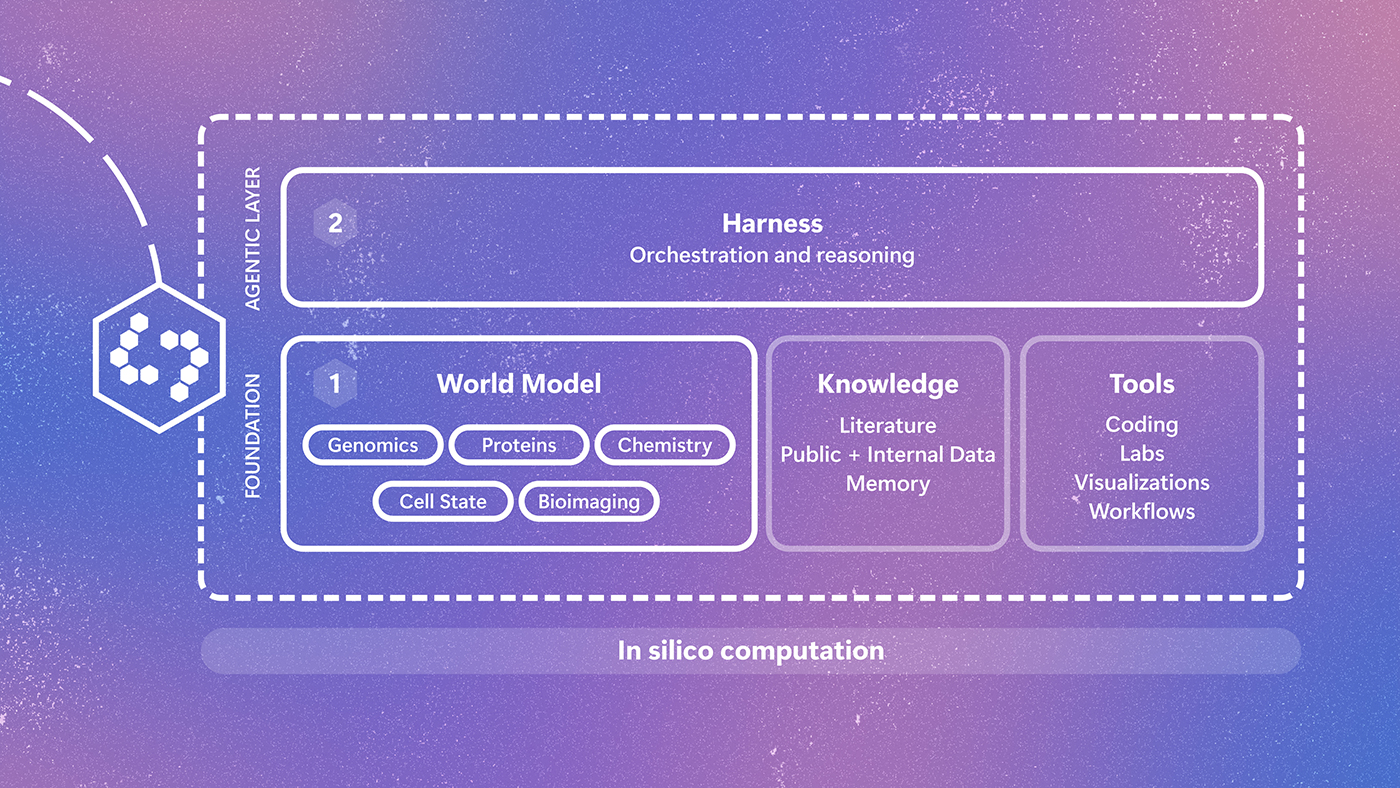
Biology doesn't operate in silos, and neither should the AI representation of it. Quine is an early-stage research effort to create a multimodal world model of biology. By connecting insights across biological scales and modalities, Quine helps scientists computationally search a space far larger than intuition allows and prioritize hypotheses before they reach the lab. Experimental results provide important feedback, helping researchers sharpen future research directions. The post Introducing Q…