The parity gap is derived, a group-theoretic metric quantifying the piezoelectric tensor freedom permitted by a crystal's proper rotation subgroup but eliminated by inversion symmetry in O(3)$, providing a unified framework to distinguish empirical error reduction from exact structural compliance with physical law.

Abstract
Crystal symmetry dictates whether a physical response tensor must vanish, establishing a direct test for machine learning predictions independent of property calculations. We derive the parity gap, a group-theoretic metric quantifying the piezoelectric tensor freedom permitted by a crystal's proper rotation subgroup $SO(3)$ but eliminated by inversion symmetry in $O(3)$. Across state-of-the-art equivariant neural network architectures, unconstrained $SO(3)$ models systematically predict forbidden non-zero responses matching the parity gap of each centrosymmetric crystal class, while polar distortion paths dynamically map output responses to the loss of inversion symmetry. Regression controls confirm that enforcing full $O(3)$ parity incurs no consistent accuracy cost across predictive tasks. Crucially, while training interventions using explicit zero labels reduce violation magnitudes, they leave residual forbidden outputs. Exact physical compliance instead requires structural enforcement through $O(3)$ representation design or explicit output antisymmetrization. The parity gap thus provides a unified framework to distinguish empirical error reduction from exact structural compliance with physical law.

Planar parity-preserving tensor networks (ppTNs) admit a fermionic formulation in which the Gaussian, efficiently contractible limit is deformed by local interactions. We investigate how many-body methods can be used to analyze such contractions in a minimal two-parameter ppTN. Its contraction is simultaneously an inte...
Maksimilian Usoltcev, Dung Hanh Nguyen, C. Wille et al.· 0 citations
Machine-learned exchange-correlation functionals correct band gaps at near-semilocal cost, while density-functional tight binding reaches the $10^3$-$10^6$-atom regime; combining them assumes that a better parent yields a better parameterization, but we show it does not. Current-generation functionals are orbital-depen...
Can Polat, Mustafa Kurban, E. Serpedin et al.· 0 citations
OrbFlow is developed, an $\mathrm{SE}(3)$-equivariant generative model that predicts Gaussian-type orbital (GTO) coefficients via flow matching that retains the efficiency of a compact atom-centered basis while replacing pointwise regression with a learned probability path over the full coefficient space.
Chen-Xing Liang, Cheng-Dong Wang, Yu-Ching Lin et al.· 0 citations
Gapped chiral phases pose an intrinsic obstruction to projected entangled pair state (PEPS) representations with finite bond dimension $D$, which generically develop spurious long-range correlations despite the gapped nature of the target state. To address this long-standing problem, we take a qualitatively different r...
Learned electronic states are usually evaluated by prediction error, even though their intended use is to accelerate the self-consistent-field (SCF) loop of density functional theory (DFT). We ask whether lower offline error actually yields a better SCF initializer. We construct $\rho$HD-43K, a 43,851-crystal DFT corpu...
Together, these results turn symmetry relaxation into a statistically justified model-selection decision and connect global signal detection to local, loss-dependent improvement.
Ze-Yu Chen· 1 citation· ⚡1
Related blog posts
MIT News · Artificial Intelligence· news.mit.eduNov 17, 2026
By studying the computational foundations of language learning, Associate Professor Jacob Andreas builds intelligent systems that can communicate effectively with humans.
MIT News · Artificial Intelligence· news.mit.eduOct 28, 2026
Professor Paris Smaragdis develops computers with superhuman hearing for applications like speech recognition, music understanding, and environmental monitoring.
MIT News · Artificial Intelligence· news.mit.eduOct 2, 2026
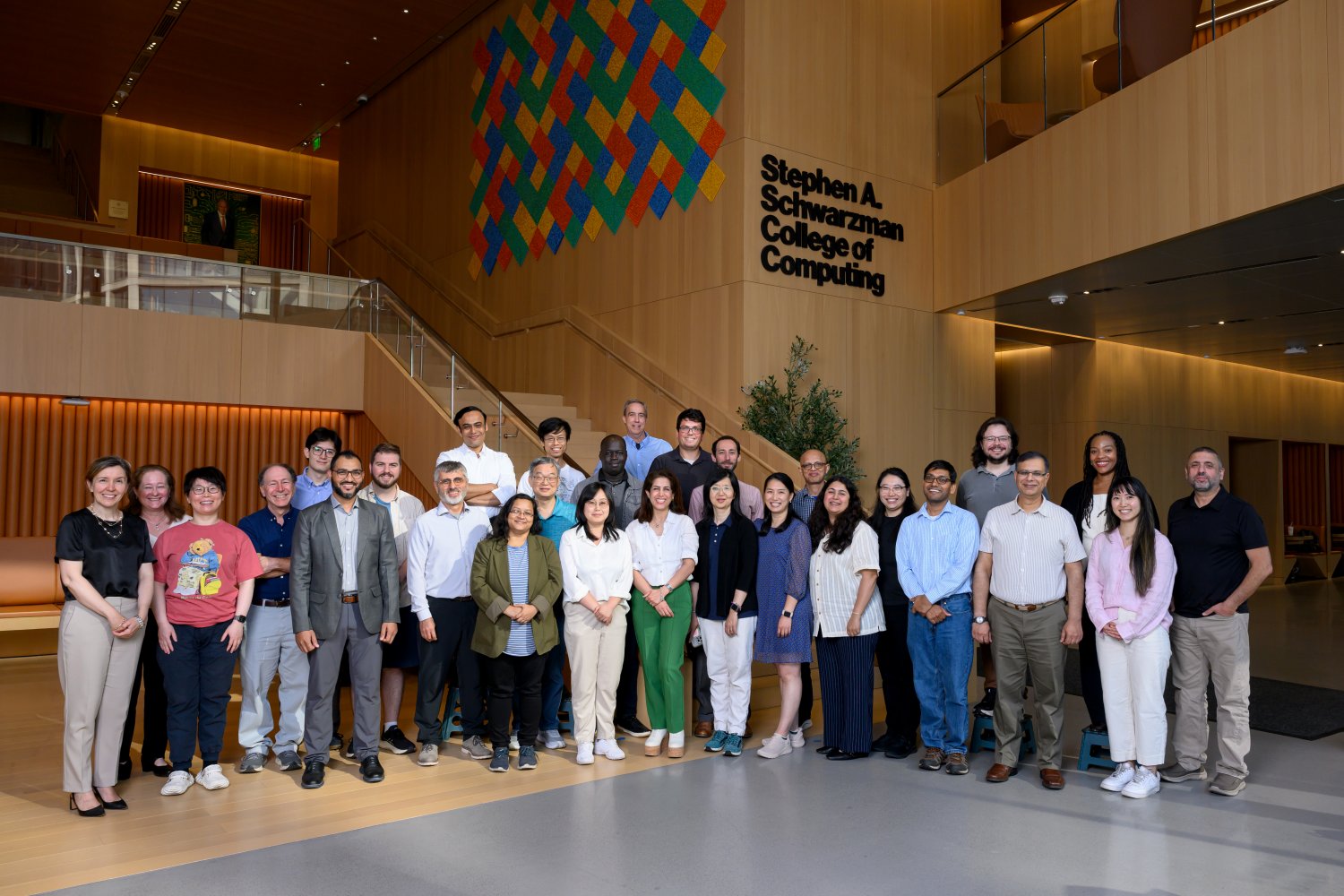
A weeklong summer workshop brought higher education faculty to campus to explore how AI and machine learning materials can be adapted for their classrooms.
We use cookies to run the site and, with your consent, for analytics and to show ads.
See our Cookie Policy.