This work proposes QFWP-ANO, a novel architecture which employs a classical hypernetwork to dynamically program VQC parameters and/or non-local observables conditioned on each input, and establishes input-conditioned ANO as an effective approach for enhancing QNNs.
Abstract
Quantum neural networks (QNNs) are typically built from variational quantum circuits (VQCs), which are limited by local measurements. Adaptive non-local observables (ANO) address this by jointly optimizing circuit parameters and multi-qubit measurements. However, existing ANO-based VQCs learn only a single static observable that remains invariant across all inputs. We propose QFWP-ANO, a novel architecture which employs a classical hypernetwork to dynamically program VQC parameters and/or non-local observables conditioned on each input. On multivariate time-series forecasting across four ETT datasets, QFWP-ANO achieves the lowest MSE in 16 of 20 settings and second-lowest in the remaining four, surpassing ANO-based and other strong baselines. On reinforcement learning tasks, QFWP-ANO consistently surpasses ANO-VQCs. Our results establish input-conditioned ANO as an effective approach for enhancing QNNs.
Numerical results show that the learned architectures recover known benchmark strategies, adapt to dephasing noise, and outperform fixed hardware-efficient ans\"atze while using fewer entangling gates, establishing AutoQSense as a resource-aware approach to adaptive and hardware-compatible quantum sensing.
Training quantum neural networks (QNNs) on near-term hardware remains hampered by two compounding difficulties: the exponential vanishing of gradient variance known as the barren plateau, and the $\mathcal{O}(L \cdot 2^n)$ time and memory cost of differentiating through an $n$-qubit, $L$-layer circuit. We propose RLQ-G...
This paper repurposes uniformly controlled rotations from static state preparation and static data encoding into a state-encoding interface for quantum neural networks, elevating the process of integrating classical states into quantum neural networks to an independent method-ological layer and achieves a more stable p...
Jun-Chen Han, Feng-Tao Xiang, Hao Shi et al.· Chinese Physics B· 0 citations
Building a quantum machine learning (QML) model competitive with a classical baseline currently requires a practitioner to separately choose a circuit architecture, a data-encoding scheme, a model paradigm (kernel versus variational), and a set of training hyperparameters, then verify after the fact that the chosen cir...
A reinforcement learning framework that embeds a deterministic Commutation-and-Reduction (CR) algorithm directly into the training environment, enabling the agent to focus its learning capacity on the non-trivial optimizations where reinforcement learning adds real value.
Khoa Dang Tao, Sumin Jin, M. Raza et al.· 0 citations
This work introduces an adaptive relational learning framework for multi-instance quantum data that accesses pairwise and higher-order relations and opens routes to sensing and quantum-data applications where adaptive photonic QML can access relational features that are costly to recover with non-adaptive, measure-firs...
Marcin Jastrzębski, Yu Shang, Raj B. Patel et al.· 0 citations
Related blog posts
MIT News · Artificial Intelligence· news.mit.eduOct 2, 2026
A weeklong summer workshop brought higher education faculty to campus to explore how AI and machine learning materials can be adapted for their classrooms.
MIT News · Artificial Intelligence· news.mit.eduAug 27, 2026
A new machine-learning framework aims to improve the success rate of computational protein design while moving away from results that reproduce sequences found in nature.
Microsoft Research Blog· microsoft.comAug 20, 2026
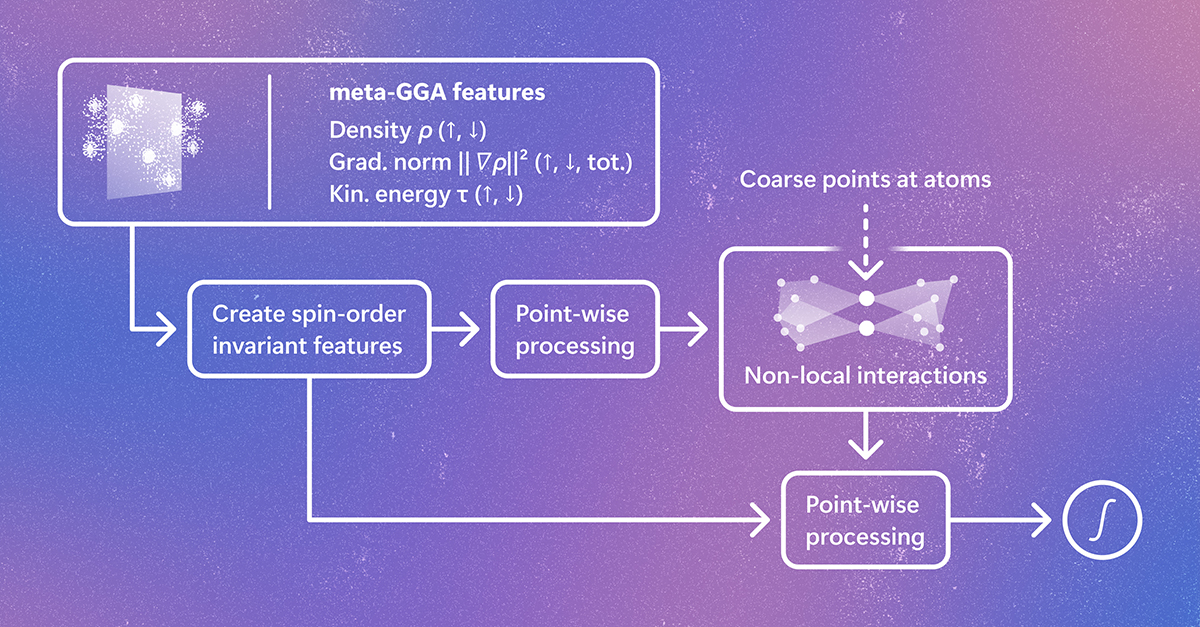
Skala 1.1, the updated deep-learning exchange-correlation functional from Microsoft Research, provides greater accuracy, expanded accessibility across the computational chemistry ecosystem, and a living benchmark to track computational performance. The post Broadening access to Skala creates a faster path to predictive DFT appeared first on Microsoft Research.
We use cookies to run the site and, with your consent, for analytics and to show ads.
See our Cookie Policy.