This paper proposes a training paradigm where Mode Seeking meets Mean Seeking, decoupling local fidelity from long-term coherence based on a unified representation via a Decoupled Diffusion Transformer, and closes the fidelity-horizon gap by jointly improving local sharpness, motion and long-range consistency.
Abstract
Scaling video generation from seconds to minutes faces a critical bottleneck: while short-video data is abundant and high-fidelity, coherent long-form data is scarce and limited to narrow domains. To address this, we propose a training paradigm where Mode Seeking meets Mean Seeking, decoupling local fidelity from long-term coherence based on a unified representation via a Decoupled Diffusion Transformer. Our approach utilizes a global Flow Matching head trained via supervised learning on long videos to capture narrative structure, while simultaneously employing a local Distribution Matching head that aligns sliding windows to a frozen short-video teacher via a mode-seeking reverse-KL divergence. This strategy enables the synthesis of minute-scale videos that learns long-range coherence and motions from limited long videos via supervised flow matching, while inheriting local realism by aligning every sliding-window segment of the student to a frozen short-video teacher, resulting in a few-step fast long video generator. Evaluations show that our method effectively closes the fidelity-horizon gap by jointly improving local sharpness, motion and long-range consistency. Project website: https://primecai.github.io/mmm/.

FlowLong is presented, a training-free, architecture-agnostic, inference-time framework that harmonizes overlapping windows sampled in parallel via Tweedie matching, a manifold-constrained blend of predicted clean samples on overlaps, and stochastic early-phase sampling that yields arbitrarily long, phase-locked audio-...
Jangho Park, G. Park, Gihyun Kwon et al.· 0 citations
This work instantiates VDN on MiniMax H3, which combines local Softmax attention with bidirectional linear memory for long-range video context and introduces Video Delta Attention (VDA), which updates memory once per frame by jointly incorporating its spatial tokens.
The decoupled self-forcing distillation resolves both models under one frozen teacher: conditioned on motion, it distills the renderer into a block-causal student; unconditionally, it scores rendered rollouts against real videos, supervising motion by the video it produces.
Yan-Ru An, Rui-Yan Wang, Wen-Wu Wei et al.· 0 citations
This paper proposes SVEET, a framework that requires merely training on a pretrained bidirectional video diffusion model but supports high-quality streaming video editing in an auto-regressive fashion and proposes a decoupled training scheme that explicitly enforces the orthogonality between the optimization directions...
Yu-Jia Hu, Jia-Jun Li, Zi-Hao He et al.· 0 citations
LoGo is introduced, which blends global and spatially localized rewards for camera-controlled video models, and effectively reduces local object shifts, artifacts, and global scene changes, illustrating the importance of credit assignment in post-training video models.
Ziqi Ma, Shreya Sharma, Mohamed El Banani et al.· 0 citations
World models, game simulators, and long-take video creation require coherent scene evolution and sustained dynamics over extended durations. Autoregressive (AR) video diffusion provides a natural framework for long-horizon generation, yet extended rollouts often become near-static or lose visual quality. We hypothesize...
Byoungwoo Park, Jaemoo Choi, Juho Lee et al.· 0 citations
Related blog posts
MIT News · Artificial Intelligence· news.mit.eduOct 28, 2026
Professor Paris Smaragdis develops computers with superhuman hearing for applications like speech recognition, music understanding, and environmental monitoring.
Exploring how generative AI could make machine vision more accessible to businesses. The post GenEye in a Box: Making Machine Vision Something You Can Just Ask For appeared first on GPT-Lab.
Microsoft Research Blog· microsoft.comAug 11, 2026
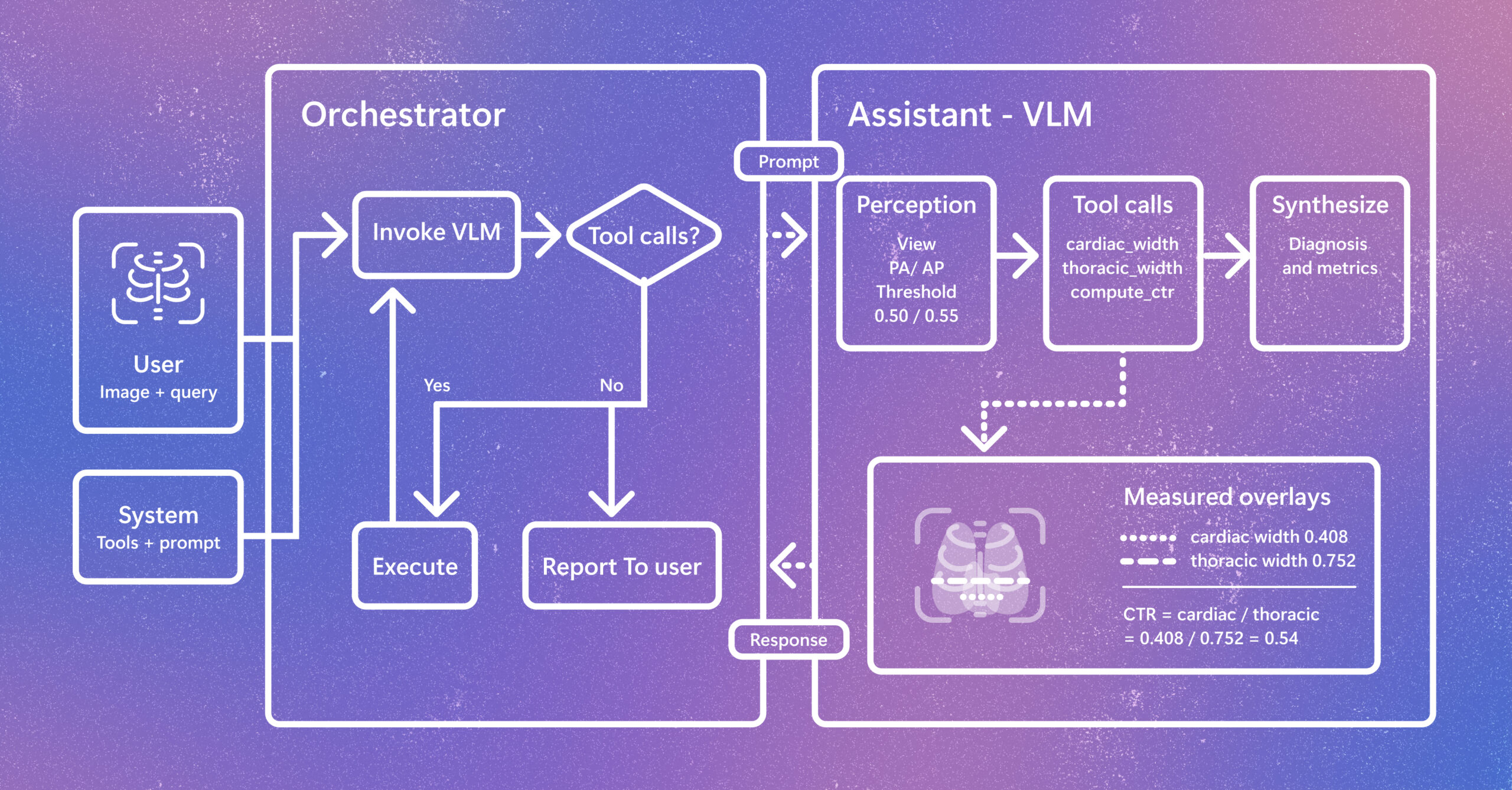
Radiology AI is evolving beyond report generation. CARE-X explores a unified approach that combines flexible reasoning, calibrated predictions, and measurement-based tools for chest X-ray interpretation. The post Introducing CARE-X: Towards Clinically Useful Radiology VLMs with Auxiliary Supervision, Reward-Aligned Learning, and Tool-Augmented Measurement appeared first on Microsoft Research.