Tabby, a long context probabilistic time series foundation model, is released together with a complete and open recipe of how it was built, which achieves competitive zero-shot forecasting performance on GIFT-Eval and the out-of-distribution TIME benchmark.
Abstract
In this report, we release Tabby, a long context probabilistic time series foundation model, together with a complete and open recipe of how it was built. Tabby adopts an encoder-only patch Transformer architecture and concentrates the contributions on the data and the training procedure. The pretraining corpus combines an extended real-world collection, GIFT-Eval-Pretrain+ and BLAST, with synthetic data from KernelSynth and CauKerV2, an online generator that composes temporal dynamics through randomly sampled structural causal models. Training couples a progressive convergence schedule, which yields reusable intermediate checkpoints, with a deep quantile supervision objective for intermediate layers. The resulting 145M parameter backbone supports contexts of up to 8,192 observations and serves forecasting, classification, and anomaly detection, while a prompt-tuning module further improves in-distribution forecasting performance with the pretrained weights frozen. Tabby achieves competitive zero-shot forecasting performance on GIFT-Eval and the out-of-distribution TIME benchmark, while the same pretrained backbone also supports classification on the UCR Archive and zero-shot anomaly detection on TSB-AD-U. We release training pipeline and model as open source at huawei-noah/trustworthyAI.
A novel pattern-guided mixture-of-experts that expands model capacity through sparse activation and uses shallow patch similarities to constrain deep-layer routing, guiding expert specialization across heterogeneous time series and an implicit quantile network head that predicts arbitrary quantiles to characterize pred...
Xingjian Wu, Chen-Juan Guo, Xiangfei Qiu et al.· 0 citations
We study the adaptation of pretrained language models to univariate time-series forecasting through a parameter-efficient transfer learning framework, with the goal of understanding which design choices drive effective cross-modal transfer. While language models operate on discrete textual tokens, time series consist o...
Tamanna S. Kumavat, Georg Brunner, Kyriakos Flouris· 0 citations
Time series foundation models (TSFMs) have advanced primarily through architectural innovation, while training regimes for large-scale heterogeneous corpora remain under-explored. As a result, pre-training distributions are often poorly controlled with respect to domain imbalance, context requirements, prediction horiz...
Hongjie Xia, Yiding Liu, Yi-Fan Hu et al.· 4 citations
The main finding is that a frozen parent's recursive trajectory is easier to fit than the observed future with lightweight parallel exits, and a correctable residual projection along a train-selected periodic history direction is found.
Ziang Li, Yue Huang, Guoxu Zhou et al.· 0 citations
Tabular foundation models learn to predict cell values in context, whereas world-model self-supervision asks for prediction in representation space (LeCun, 2022; Assran et al., 2023). On a tabular foundation-model prior, the latent term of a joint-embedding predictive architecture (JEPA) collapsed in our earlier runs a...
Time series foundation models (TSFMs) are pretrained on heterogeneous collections containing billions of observations, yet their training windows are typically sampled without estimating whether they provide useful learning signal. We introduce a static data-selection framework that scores each window with a reference...
Martin Trust Center Managing Director Bill Aulet introduces Dear Dreamer, a free platform for middle and high school students who want to learn about entrepreneurship.
Microsoft Research Blog· microsoft.comSep 30, 2026
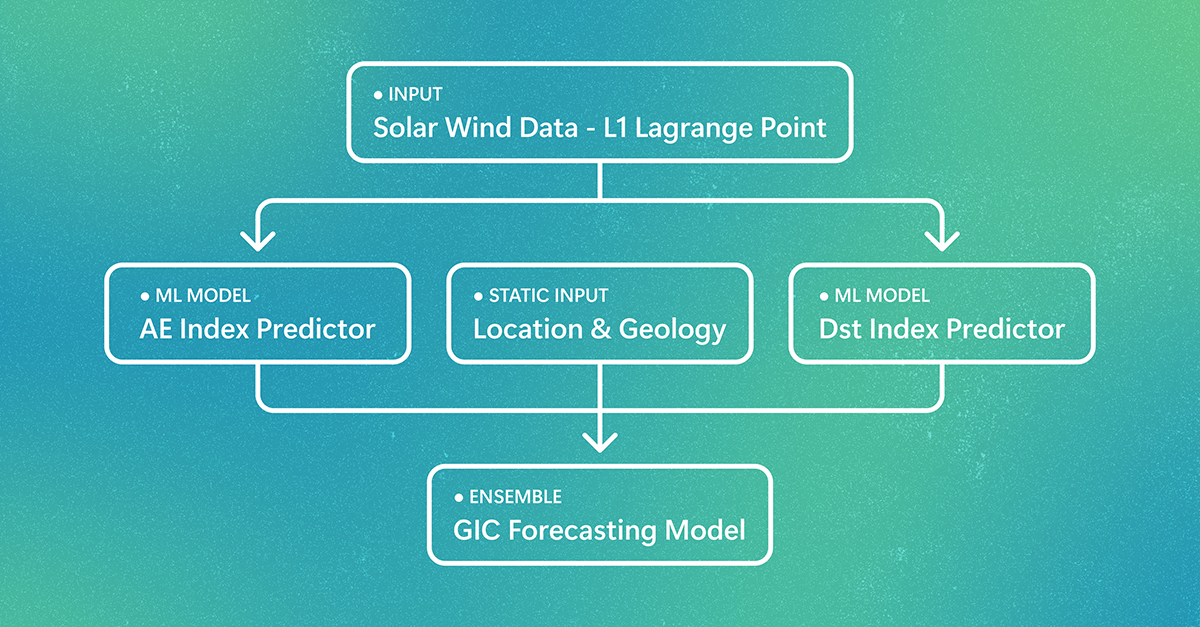
Extreme space-weather events can damage power systems on Earth and degrade GPS accuracy and satellite operations. A new machine learning system can predict where damage is likely to occur 30-60 minutes before a storm arrives. The post Forecasting space weather risks on power grids appeared first on Microsoft Research.
We use cookies to run the site and, with your consent, for analytics and to show ads.
See our Cookie Policy.