During language acquisition, bilingual children are regularly exposed to code-switched input and use it as a cognitive scaffold to accelerate vocabulary growth and cross-linguistic syntactic mapping. In contrast, computational bilingual models are conventionally pretrained on interleaved monolingual corpora. While intr...
Zhuojing Huang, Luise Pohlmann, Lisa Beinborn· 0 citations
Realistic environment replicas are increasingly valuable for training and evaluating LLM agents, yet the original systems may be inaccessible or impractical to reproduce. We explore agentic language world modeling: rather than rebuilding an executable environment, a world model agent serves as the environment for a tas...
Quanyu Long, Xiao Chen, Jianda Chen et al.· 0 citations
Large Language Model (LLM) assistants routinely decide whether they can trust users and third parties whose competence, intentions, and integrity they cannot verify. This uncertainty matters for safety, as trusting the wrong party can lead an agent to comply with harmful requests or act on malicious instructions encoun...
Th\'eo Lasnier, Romain Froger, Maxence Lasbordes et al.· 0 citations
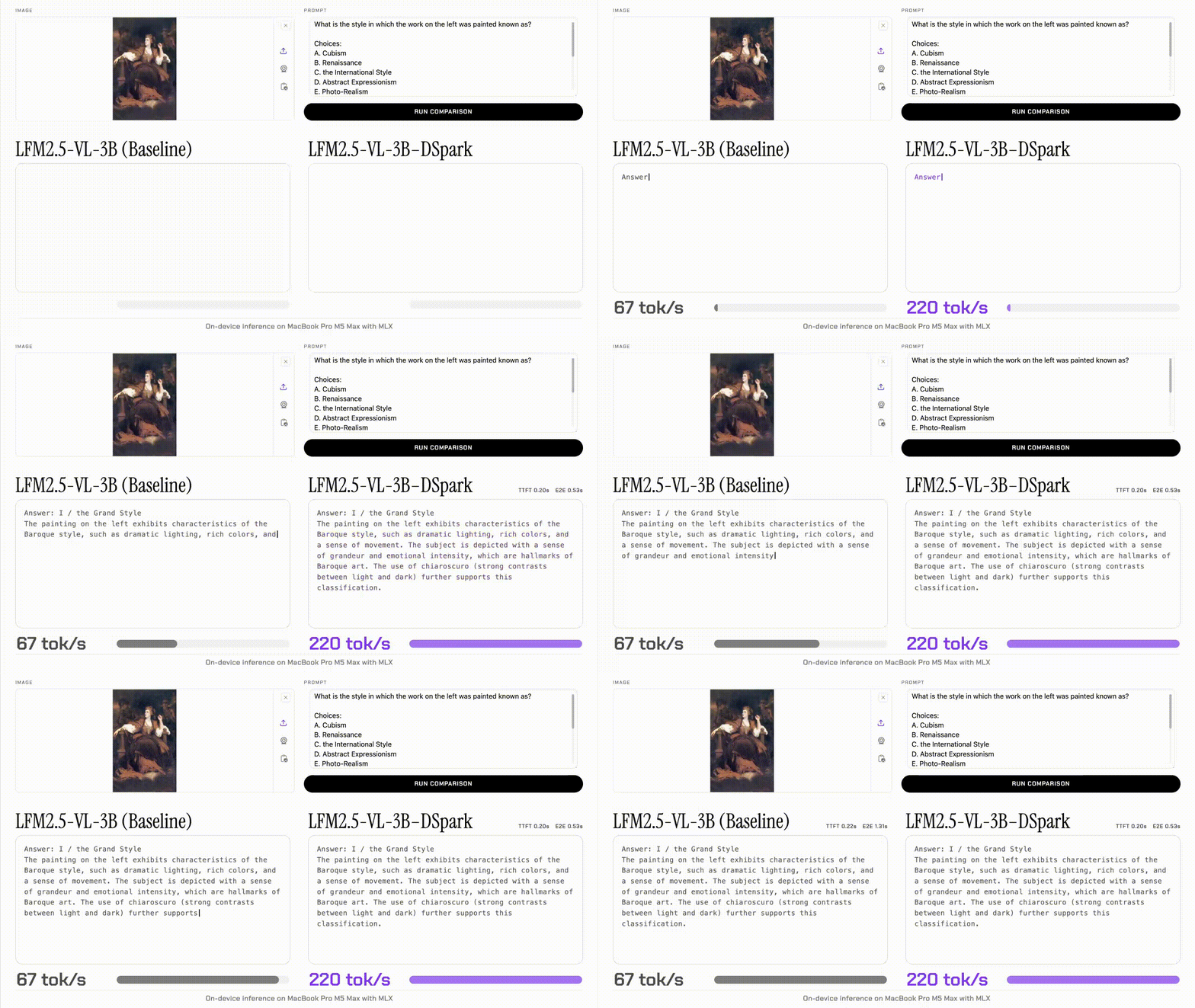
Block diffusion accelerates speculative decoding by drafting multiple tokens in one forward pass. However, each position predicts a marginal distribution without observing earlier proposed tokens, limiting draft quality and acceptance length. We identify a concrete failure, the \emph{repetition trap}, in which neighbor...
Ke-Cheng Chen, Yu-Yang He, Cheng Gong et al.· 0 citations
Reach audiences
Advertise in front of researchers, engineers, and readers.
With the rapid development of artificial intelligence, the emergence of various Large Language Models (LLMs) has created a rich model ecosystem. However, this also brings a key challenge: how to select the optimal model for a specific user query. LLM routing addresses this need by dynamically assigning queries to the m...
Yao Lu, Zhai-Yuan Ji, Ya-Xin Gao et al.· 0 citations
Tokenizer-free language models remove the inductive bias of fixed tokenizers by modeling text directly as bytes, but the resulting longer sequences substantially increase computation and eliminate explicit text abstractions. We ask whether this additional computation can be useful, and whether standard Transformers can...
Jie Wang, Shi-Wei Luo, Qi Zhang et al.· 0 citations
Verifier-guided decoding can prevent harmful reasoning steps from contaminating subsequent generation, but typically relies on an external learned verifier. We ask whether a language model can instead reject its own bad reasoning steps. We define a prefix's recoverability as the probability that the frozen generator ca...
Siheng Xiong, Xiaoze Liu, Yiqiao Jin et al.· 0 citations
Masked diffusion language models (dLLMs) generate text by iteratively denoising masked positions, re-predicting each token multiple times before it is committed. An autoregressive decoder exposes an answer's distribution once, at the step that commits it; a dLLM exposes it at every denoising step before commitment, and...
Sarim Hashmi, Mukul Ranjan, Abdelrahman W. A. Elsayed et al.· 0 citations
Linear attention enables efficient long-context autoregressive decoding by compressing history into recurrent states, but this compression can make selective access to sparse and distant information difficult. Existing chunk-based extensions increase memory capacity, yet learned chunk-mixing coefficients may remain fix...
Zhuo-Kun Chen, Xi Lin, Xi-Yu Wu et al.· 0 citations
Continuous language flows generate text by denoising all positions of a target canvas together. The natural way to add reasoning to such a model is to write a trace ahead of the answer, but the trace length changes from question to question. The answer start is therefore unknown during denoising, and the model has to d...
Miaohe Niu, Pengxiang Li, Jingbo Zhu et al.· 0 citations
Low-Rank Adaptation (LoRA) achieves parameter-efficient fine-tuning by constraining model updates to a low-rank subspace and has been widely used in practice. However, LoRA typically employs a shared low-rank update across tokens, which limits its ability to fully exploit the adaptation subspace for tokens from differe...
Guang Yang, Chang-Hao Guan, Chao Huang et al.· 0 citations
LLM agents are increasingly built for medical work and scored on clinical benchmarks. Each such score, however, comes from a model running inside an agent harness, the system that controls the loop between the model and its environment. An agent's score is therefore a property of a model--harness pair. For medical agen...
A new method, called CW-Net, translates the reasoning process of an autonomous vehicle’s AI system into understandable concepts that explain its behavior.
MIT News · Artificial Intelligence· news.mit.eduAug 31, 2026
With millions of users across the world, Julia has been used to conduct cutting-edge research and to design new drugs, jet engines, heat pumps, and more.