On-policy self-distillation has recently emerged as an effective approach for improving language-model reasoning by supervising students with a frozen or EMA version of themselves that receives privileged information. Its application to multimodal large language models (MLLMs), however, remains largely unexplored. Rece...
Sophia Sirko-Galouchenko, Monika Wysoczanska, Andrei Bursuc et al.· 0 citations
Despite progress in vision-language models, 3D spatial reasoning from 2D images remains challenging. Text-based methods describe intermediate geometry with discrete tokens, limiting fidelity for continuous spatial relations. Continuous latents offer richer representations, but a single latent type does not explicitly s...
Ya-Kun Zhu, Yi Bin, Yu-Juan Ding et al.· 0 citations
Recent vision-language models (VLMs) exhibit remarkable generalization and reasoning abilities, yet 3D understanding in these models is limited by data scale, training diversity, and reasoning capacity. Instead of naively extending these models into 3D, we take a different approach: we enable powerful 2D VLMs to operat...
Arman Raayatsanati, Sombit Dey, Anna-Maria Halacheva et al.· 0 citations
Invisible watermarking has become a central tool for tracing AI-generated images, but its robustness against adaptive removal attacks remains an open security question. We introduce Latent Frequency Masking, an attack that erases watermark evidence by replacing selected Fourier coefficients in the latent representation...
Kirill Aistov, Khaled Abud, I. Serzhenko et al.· 0 citations
Reach audiences
Advertise in front of researchers, engineers, and readers.
Latent visual reasoning equips vision--language models with continuous intermediate states that can process visual evidence without explicit textual reasoning traces or repeated image operations. However, existing methods often allow multiple latent tokens to access the same visual evidence through shared value project...
Yingcheng Liu, Tian-Yi Jiang, Yu-Juan Ding et al.· 0 citations
Deep generative networks have recently achieved unprecedented performance in precise image and video editing using sophisticated textual prompts. However, the effectiveness of such models heavily depends on access to very large supervised and annotated image datasets, which can be very difficult to obtain. This is part...
Victor Enescu, Assaad Zeghina, Matthieu Meignin et al.· 0 citations
Processing long videos with Vision-Language Models (VLMs) is bottlenecked by the quadratic cost of visual tokens, making long-form inference prohibitively expensive. While single-axis compression methods mitigate this, they hit a hard efficiency floor because they treat spatial and temporal redundancy independently. We...
Video Anomaly Detection (VAD) aims to temporally localize abnormal events in videos. Most existing approaches rely on dataset-specific training and curated annotations, limiting generalization in open-set scenarios. Recent zero-shot methods based on Large Vision- Language Models (LVLMs) alleviate this dependency but of...
Mohd Ubaid Wani, Sara Atito, Josef Kittler et al.· 0 citations
Test-time scaling often seeks better answers by sampling multiple responses from a frozen model, yet conventional temperature sampling generates every candidate along the same fixed computation path. We introduce architectural sampling, a training-free method that generates candidates through distinct forward computati...
Akshit Singh, Shyam Marjit, Wei Lin et al.· 1 citation
Vision-language models (VLMs) face a fixed-budget trade-off between processing more visual information for fine-grained perception and using a larger language backbone for complex reasoning. Existing studies do not tell us which combination of backbone size and input resolution to deploy, especially in high-resolution...
Xinye Zhao, Yun-Kai Dang, Yun-Chen Wu et al.· 0 citations
Reliable visual reasoning requires composing multiple visual observations and returning consistent answers to logically equivalent questions. We introduce Hob-VL, a benchmark for visually grounded Boolean reasoning. Hob-VL comprises two tasks: (1) evaluating whether a Boolean rule holds in an image, and (2) identifying...
Video Large Language Models (VideoLLMs) receive frames in sequential order and interpret how visual content evolves along the temporal axis, yet temporal reasoning remains a persistent weakness across architectures. Reversing the frame order of a video, a transformation that should invert temporal answers, often leaves...
Youngwoo Shin, Yusung Ro, Minseo Kim et al.· 0 citations
Exploring how generative AI could make machine vision more accessible to businesses. The post GenEye in a Box: Making Machine Vision Something You Can Just Ask For appeared first on GPT-Lab.
Jennifer Neville did not want to go into computer science—but that’s exactly where she landed. Neville discusses the starts and stops that led to her professional sweet spot and her work identifying “surprising failures” making it hard for AI to handle complexity. The post What AI gets wrong and what failure teaches us appeared first on Microsoft Research.
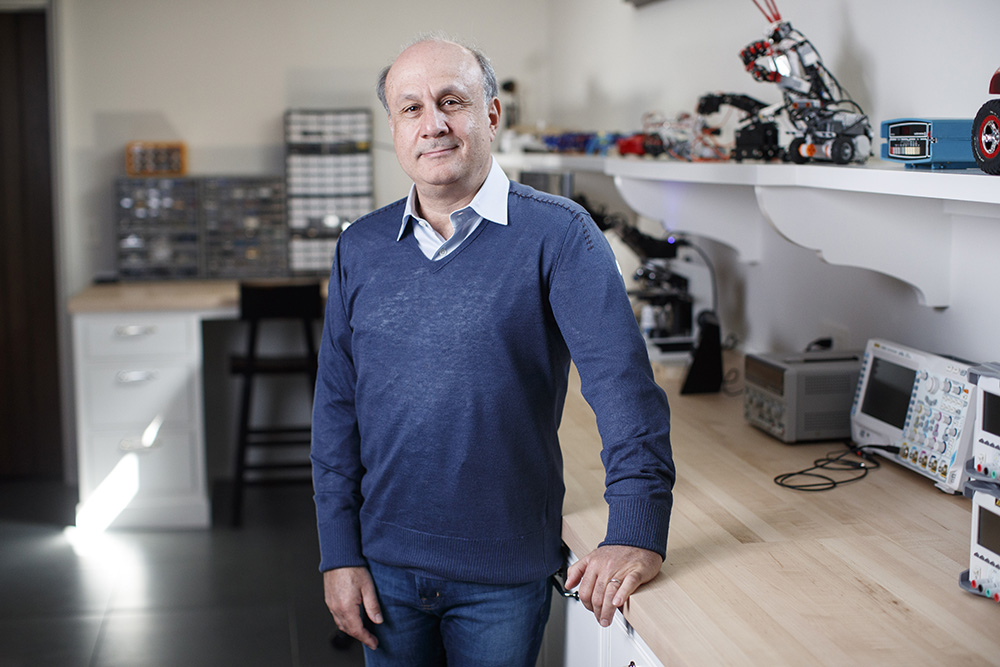
Computer scientist, entrepreneur, and philanthropist will collaborate with the MIT Schwarzman College of Computing to advance AI and scientific discovery.