Solving complex long-horizon robotic tasks requires joint reasoning over abstract task structure and low-level physical interaction. While combining Vision-Language Models (VLMs) and video generation models offers a promising path for zero-shot planning, their individual tendencies to hallucinate physics or violate geo...
Jiahui Fu, Junyu Nan, Lingfeng Sun et al.· 0 citations
This work proposes MeCSAFNet, a multi-branch encoder-decoder architecture for land cover segmentation in multispectral imagery. The model separately processes visible and non-visible channels through dual ConvNeXt encoders, followed by individual decoders that reconstruct spatial information. A dedicated fusion decoder...
Many physical systems do not merely move or deform; they grow, adding material and changing the geometry that a world model must represent. Existing world models are typically optimized for pixel prediction, reward prediction, or fixed-support physical dynamics, leaving open how to model systems whose underlying physic...
Generative Artificial Intelligence (GenAI) constitutes a transformative technological wave that reconfigures industries through its unparalleled capabilities for content creation, reasoning, planning, and multimodal understanding. This revolutionary force offers the most promising path yet toward solving one of enginee...
Yuping Wang, Shuo Xing, Cui Can et al.· 0 citations
Reach audiences
Advertise in front of researchers, engineers, and readers.
As AI models grow more complex, explainability is essential for building trust, yet concept-based counterfactual methods still face a trade-off between expressivity and efficiency. Representing underlying concepts as atomic sets is fast but misses relational context, whereas full graph representations are more faithful...
Angeliki Dimitriou, Nikolaos Chaidos, Maria Lymperaiou et al.· 0 citations
Structured radiology reporting promises faster, more consistent communication than free text, but automation remains difficult as models must make many fine-grained, discrete decisions about rare findings and attributes from limited structured supervision. In contrast, free-text reports are produced at scale in routine...
Chantal Pellegrini, Adrian Delchev, Ege \"Ozsoy et al.· 0 citations
As we move through the world and carry out everyday tasks, we encounter objects that may become relevant only later. We are capable of recalling where we left something or what was inside a container, even without knowing we would need it later. Here, we study how an embodied assistant can build a similar memory from e...
Shravan Chaudhari, William Paul, Suchi Saria et al.· 0 citations
Real-time robot control demands enough visual history to infer motion and task progress, but processing that history can delay action. We present Long-WAM, a model-system framework for scaling the context of causal world-action models under real-time control constraints. Our central finding is that access to history is...
Wei Huang, Bohan Zhang, Chenzhi Liu et al.· 0 citations
Recent advances in multimodal foundation models have made them capable generalist physical agents for a range of manipulation tasks. However, successful operation in an unfamiliar environment may require an agent to seek task-relevant information through interaction when it is absent from the observations: it may need...
Liu Renhang, Navonil Majumder, Tej Deep Pala et al.· 0 citations
Pretrained models for cell and nuclear instance segmentation differ substantially in architecture, pretraining data and objectives, parameter count, inference strategy, adaptation requirements, postprocessing pipeline, and computational demand. Large pretrained and foundation models are increasingly adopted because of...
Dense self-expression matrices and full-affinity spectral clustering limit the scalability of subspace clustering. We introduce the Latent Orthogonal Optimization Model for Subspace Clustering (LoomSC), a framework that addresses both bottlenecks through projector factorization and exact spectral reduction. Motivated b...
Nairouz Mrabah, Youssef Melki, Mohamed Bouguessa et al.· 0 citations
Long video understanding increasingly relies on external memory to organize massive visual streams into compact representations. However, most memory-based methods dynamically adapt how information is retrieved for different questions, while largely fixing what is remembered. This mismatch makes missing details costly...
Yongchao Xu, Bowen Ye, Jiefeng Gan et al.· 0 citations
Exploring how generative AI could make machine vision more accessible to businesses. The post GenEye in a Box: Making Machine Vision Something You Can Just Ask For appeared first on GPT-Lab.
Jennifer Neville did not want to go into computer science—but that’s exactly where she landed. Neville discusses the starts and stops that led to her professional sweet spot and her work identifying “surprising failures” making it hard for AI to handle complexity. The post What AI gets wrong and what failure teaches us appeared first on Microsoft Research.
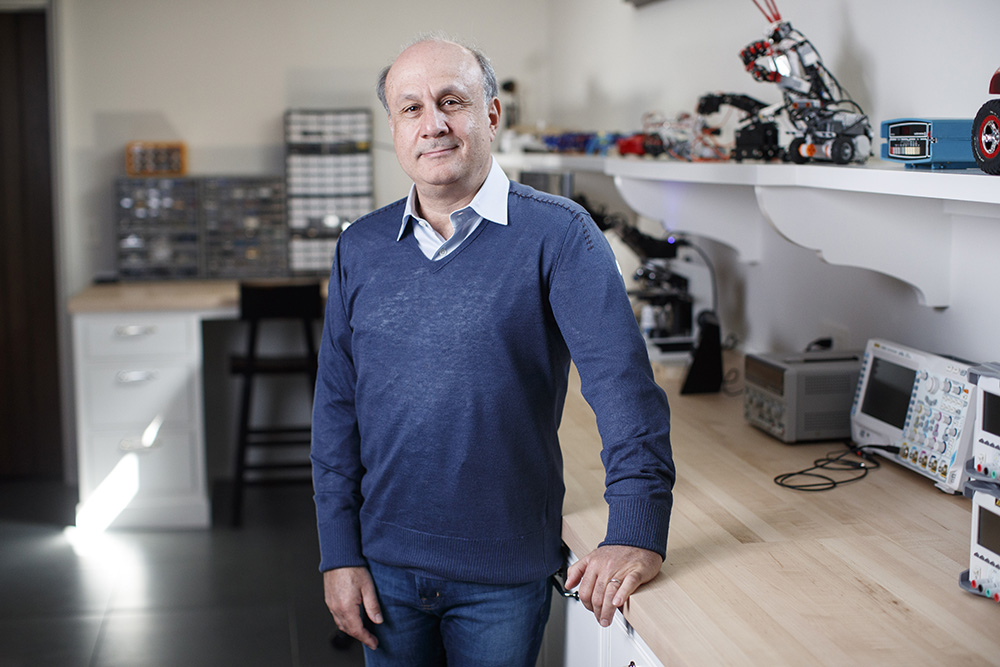
Computer scientist, entrepreneur, and philanthropist will collaborate with the MIT Schwarzman College of Computing to advance AI and scientific discovery.