E-commerce videos are information-dense and frequently compared by consumers evaluating products and merchants assessing marketing strategies. However, existing multimodal models mainly focus on single-video understanding and have limited ability to compare information across videos. We introduce AdsCVR, the first e-co...
Jinghan Zhao, Yiman Hu, Liang Wu et al.· 0 citations
Text-to-image (T2I) models are judged by benchmarks that measure whether requested content appears, but these benchmarks largely overlook the complementary ability to satisfy negated constraints, for example, generating"a non-red cup."Measuring negation raises challenges not faced by affirmation-based benchmarks and re...
Omar Elfatairy, M. A. Bravo, Jessica Bader et al.· 0 citations
We present WebFovea, a vision-based web agent that placed 2nd in the WebRetriever Challenge 2026 with a final score of 57.0 out of 100. The challenge evaluates agents end to end on Protocol III of the WebRetriever benchmark (arXiv:2607.06118): starting from an entry URL on a live website, the agent must operate the sit...
Accurate 3D detection is essential for mobile embodied agents, while Vision Foundation Models (VFMs) offer transferable visual and geometric priors. Yet existing VFM-based 3D detectors rely on narrow-view monocular images or discrete perspective views, limiting coherent surround perception; equirectangular projection (...
Run-Tong Wu, Fei Teng, Di Wen et al.· 0 citations
Reach audiences
Advertise in front of researchers, engineers, and readers.
Recent text-to-image generation models have achieved remarkable visual quality, but improving them through post-training remains challenging because no single reward signal captures the full range of human preference. In this work, we develop a simple and effective post-training recipe for open-domain text-to-image gen...
Yuan-Hao Ban, I-Hung Hsu, A. Angelopoulos et al.· 0 citations
Multimodal Large Language Models (MLLMs) suffer from hallucinations, creating a critical need for Uncertainty Quantification (UQ) to ensure reliable deployment. However, existing approaches struggle to detect uncertainty caused by superficial associations, especially when the query-relevant signal is weak. We mainly at...
Haoyang Luo, Linwei Tao, Jie Gui et al.· 0 citations
Vision-Language-Action (VLA) foundation models have scaled rapidly to enhance manipulation performance and generalizability, but this scaling incurs high computational costs that render real-world deployment increasingly challenging. Existing approaches typically mitigate this issue by designing smaller architectures o...
Yoojin Oh, Jeongsol Kim, Yeonwoo Seo et al.· 0 citations
The practical success of conditional image generation hinges on fine-grained differences in condition alignment and visual fidelity. Classifier-free guidance (CFG) is central to this success, but its lack of an explicit criterion makes it difficult to assess whether the guided trajectory is progressing as intended. To...
Vision-language models such as CLIP exhibit strong semantic generalization, but remain limited in fine-grained visual perception. A recent work named KUEA presents a natural remedy by finetuning the image encoder under the supervision of the vision-centric DINOv2 to align their kernel matrices element-wisely, while reg...
Peilin Yang, Xiaoyu Liu, Jian Sun et al.· 0 citations
Diffusion transformers (DiTs) generate high-fidelity images from text and image conditions, but their outputs carry large variance and their faithfulness to a desired target depends heavily on how the condition is supplied. We present DAGS, a lightweight, attention-free, disentangled appearance and geometry conditionin...
Karthik Mohan Kumar, Damian Andrysiak, Pedro Antonio Pena et al.· 0 citations
Large-scale vectorized HD maps provide structured road information that is essential for perception, localization, and planning in autonomous driving. Constructing such maps requires aggregating noisy, fragmented, and overlapping local predictions collected along a vehicle trajectory into a coherent global map. Existin...
Ziwei Li, Yi-Tang Chen, Xiaoqi Wang et al.· 0 citations
Dento-maxillofacial cone-beam CT (CBCT) reports may contain dozens of tooth-specific, anatomical, and spatial findings from a single 3D scan. Learning to generate such reports from limited clinical data is challenging because routine reports may not exhaustively document image findings, and a non-mention may reflect ei...
Ruiyang Hao, Zhi Qin Tan, Yulan He et al.· 0 citations
Exploring how generative AI could make machine vision more accessible to businesses. The post GenEye in a Box: Making Machine Vision Something You Can Just Ask For appeared first on GPT-Lab.
Jennifer Neville did not want to go into computer science—but that’s exactly where she landed. Neville discusses the starts and stops that led to her professional sweet spot and her work identifying “surprising failures” making it hard for AI to handle complexity. The post What AI gets wrong and what failure teaches us appeared first on Microsoft Research.
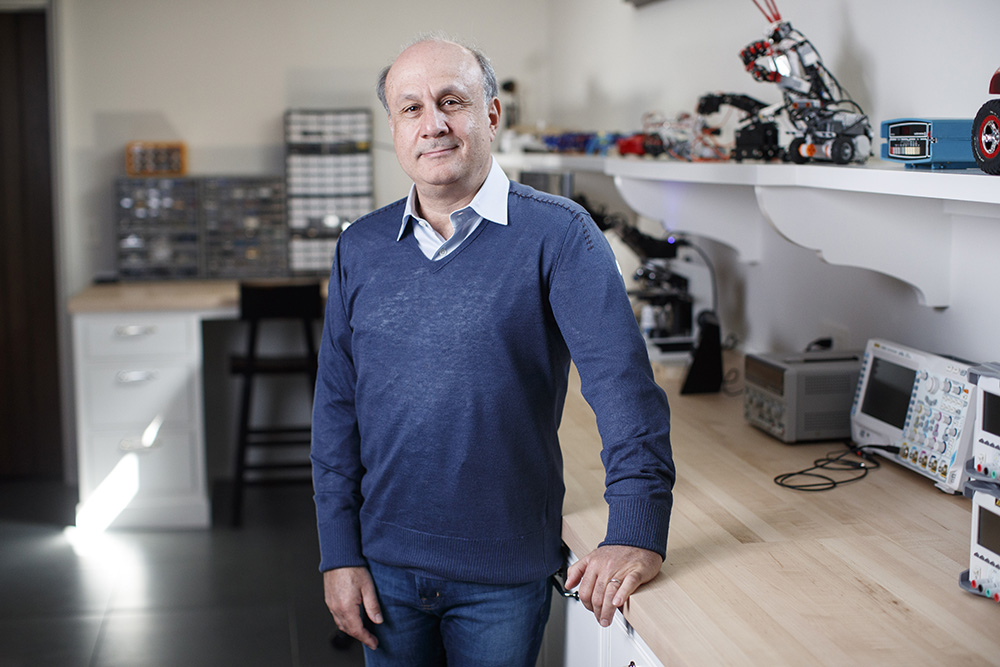
Computer scientist, entrepreneur, and philanthropist will collaborate with the MIT Schwarzman College of Computing to advance AI and scientific discovery.