We propose a fully automated AI system that produces short comedic videos similar to sketch shows such as Saturday Night Live. Starting from character references, the system employs a population of agents loosely modeled on roles in real production studios and structured to optimize the quality and diversity of ideas a...
Susung Hong, Brian Curless, Ira Kemelmacher-Shlizerman et al.· 0 citations
In this paper, we propose a Rectified Flow Auto Coder (RAC) inspired by Rectified Flow to replace the traditional VAE: 1. It achieves multi-step decoding by applying the decoder to flow timesteps. Its decoding path is straight and correctable, enabling step-by-step refinement. 2. The model inherently supports bidirecti...
Sen Fang, Yalin Feng, Yanxin Zhang et al.· 0 citations
Obstructions such as raindrops, fences, or dust degrade captured images, especially when mechanical cleaning is infeasible. Conventional solutions to obstructions rely on a bulky compound optics array or computational inpainting, which compromise compactness or fidelity. Metalenses composed of subwavelength meta-atoms...
Seungwoo Yoon, Dohyun Kang, Eunsue Choi et al.· 0 citations
We show that deep neural networks trained across diverse tasks exhibit remarkably similar low-dimensional parametric subspaces. We provide the first large-scale empirical evidence that demonstrates that neural networks systematically converge to shared spectral subspaces regardless of initialization, task, or domain. T...
Prakhar Kaushik, Shravan Chaudhari, Ankit Vaidya et al.· 0 citations
Reach audiences
Advertise in front of researchers, engineers, and readers.
The advancement of robotics and autonomous navigation systems hinges on the ability to accurately predict terrain traversability. Traditional methods for generating datasets to train these prediction models often involve putting robots into potentially hazardous environments, posing risks to equipment and safety. To so...
Shreya Gummadi, Mateus V. Gasparino, Gianluca Capezzuto et al.· 0 citations
Mammography, an X-ray-based imaging technique, remains central to the early detection of breast cancer. Recent advances in artificial intelligence have enabled increasingly sophisticated computer-aided diagnostic methods, evolving from patch-based classifiers to whole-image approaches and then to multi-view architectur...
In this paper, we address the problem of human trajectory forecasting, which aims to predict the inherently multi-modal future movements of humans based on their past trajectories and other contextual cues. We propose a novel motion prediction conditional flow matching model, termed MoFlow, to predict K-shot future tra...
As embodied AI and world models increasingly operate in dynamic 3D environments, visual perception must move beyond passively interpreting given observations toward actively deciding what to observe. We study this problem through camera planning in dynamic 3D story worlds, where the camera must not only generate smooth...
Jiaming Bian, Bingliang Li, Yuehao Wu et al.· 0 citations
Pipeline figures in ML papers must be repurposed across many canvases, including paper columns, 16:9 slides, portrait posters, 1:1 social teasers, 9:16 phone previews. Each format imposes a different aspect ratio on the same computational graph, where any silently broken connection misrepresents the method. We formulat...
Shih-Chen Tseng, Chih-Hsuan Chen, Ryan Yang et al.· 0 citations
Multimodal Diffusion Transformers (MM-DiTs) jointly process visual and textual representations throughout generation. These models repeatedly update the text tokens through multimodal attention, forming dynamic contextual tokens whose function is not well understood. In this work, we introduce a framework for reading t...
Omer Dahary, Etai Sella, Hadar Averbuch-Elor et al.· 0 citations
Sliders provide an intuitive interface for continuous image editing. In current generative approaches, however, the slider is simply a rescaling of the method's strength parameter, such as an adapter coefficient, a prompt weight, or an interpolation factor. This strength relates poorly to perceptual change. The image c...
David Serrano-Lozano, Duygu Ceylan, Yannick Hold-Geoffroy et al.· 0 citations
World models learn to predict how their environment will evolve, making them an important foundation for general-purpose robotic control. Yet world action models depend on camera inputs whose manipulation can corrupt the visual representations used across tasks and action policies. Existing attacks on these models opti...
Xuanyu Lu, Fengqing Jiang, Kaiyuan Zheng et al.· 0 citations
Exploring how generative AI could make machine vision more accessible to businesses. The post GenEye in a Box: Making Machine Vision Something You Can Just Ask For appeared first on GPT-Lab.
Jennifer Neville did not want to go into computer science—but that’s exactly where she landed. Neville discusses the starts and stops that led to her professional sweet spot and her work identifying “surprising failures” making it hard for AI to handle complexity. The post What AI gets wrong and what failure teaches us appeared first on Microsoft Research.
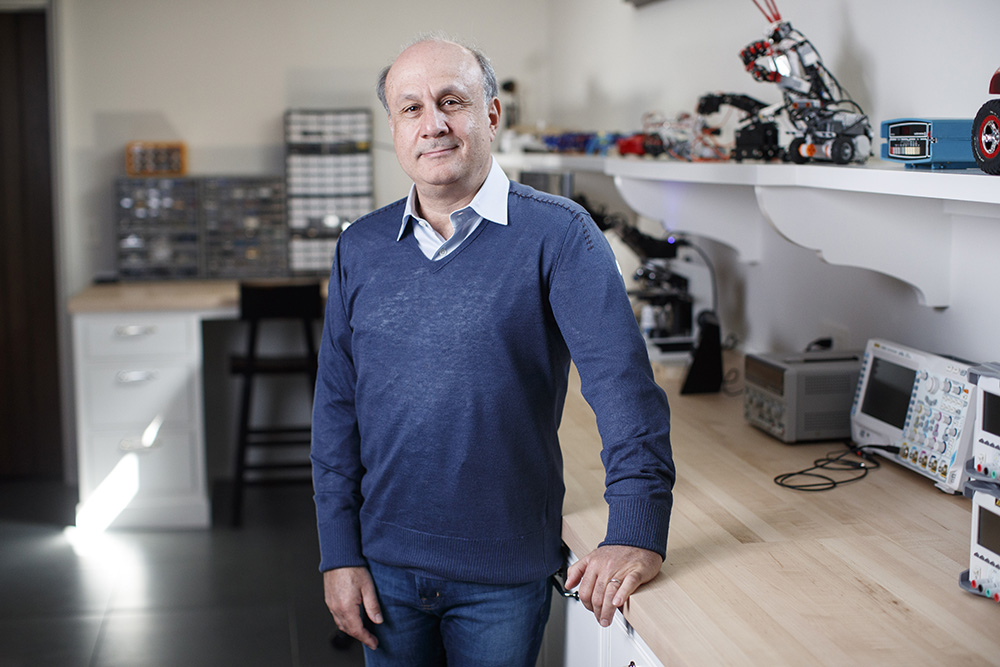
Computer scientist, entrepreneur, and philanthropist will collaborate with the MIT Schwarzman College of Computing to advance AI and scientific discovery.