
Demo Blog
August 23, 2026 · By Administrator
##Why do we use it? It is a long established fact that a reader will be distracted by the readable content of a page when looking at its layout. The point of using Lorem Ipsum is that it has a more-or-less normal distribution of letters, as opposed to using 'Content here, content here', making it look like readable English. Many desktop publishing packages and web page editors now use Lorem Ipsum as their default model text, and a search for 'lorem ipsum' will uncover many web sites still in their infancy. Various versions have evolved over the years, sometimes by accident, sometimes on purpose (injected humour and the like).
More from the blog
Measuring benchmark optimization in speech recognition
We’re on a journey to advance and democratize artificial intelligence through open source and open science.
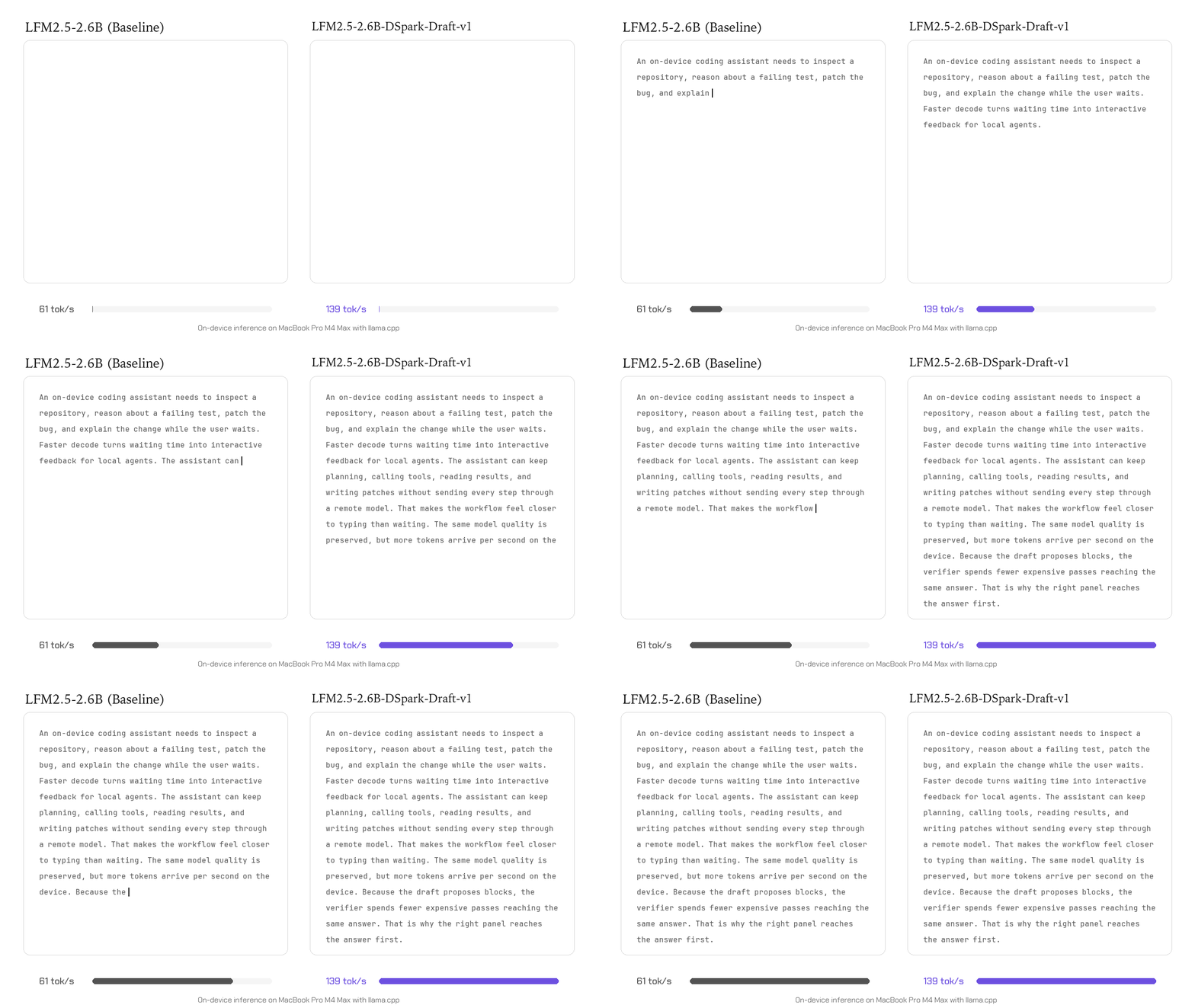
Up to 3.2x Faster Inference with LFM2.5-DSpark
A Blog post by Liquid AI on Hugging Face

How Much Memory Does Your Agent Actually Need?
A Blog post by IBM Research on Hugging Face

Multi-Vector (Late Interaction) Embedding Models with Sentence Transformers
We’re on a journey to advance and democratize artificial intelligence through open source and open science.
Related papers
EquiPocket: an E(3)-Equivariant Geometric Graph Neural Network for Ligand Binding Site Prediction
EquiPocket is proposed, an E(3)-equivariant Graph Neural Network for binding site prediction, which comprises three modules: the first one to extract local geometric information for each surface atom, the second one to model both the chemical and spatial structure of protein and the last one to capture the geometry of the surface via equivariant message passing over the surface atoms.
Guiding generative models to uncover diverse and novel crystals via reinforcement learning
A reinforcement learning framework that guides latent denoising diffusion models in finding diverse and novel, yet thermodynamically viable, crystalline compounds and demonstrates enhanced property-guided design that preserves chemical validity while targeting desired functional properties.
FlashMo: Geometric Interpolants and Frequency-Aware Sparsity for Scalable Efficient Motion Generation
This work proposes FlashMo, a frequency-aware sparse motion diffusion model that prunes low-frequency tokens to enhance efficiency without custom kernel design, and introduces MotionSiT, a scalable diffusion transformer based on a joint-temporal factorized interpolant with Lie group geodesics over SO(3) manifolds, enabling principled generation of joint rotations.
AoI Minimization in Heterogeneous MEC Networks: A Federated Learning-Assisted Hybrid DRL and Convex Approach
This paper investigates a dynamic heterogeneous mobile edge computing network (HMECN), where mobile devices (MDs) could offload their full tasks to a small base station (SBS) directly or the macro base station (MBS) in direct or relay mode. As age of information (AoI) is a comprehensive and accurate metric to capture the freshness of computation results, we formulate a long-term weighted sum AoI (LWSA) minimization problem in the HMECN by jointly optimizing the offloading decisions of MDs as well as the bandwidth and computation resource allocation of all base stations, subject to energy, delay and peak AoI constraints. To address the formulated non-convex mixed integer nonlinear programming problem, we decompose it into the offloading decision optimization (ODO) top-problem and the resource allocation optimization (RAO) sub-problem. Based on the decomposition, we propose a federated learning (FL)-assisted hybrid DRL and convex approach that is comprised of a safe multi-agent DRL algorithm, convex optimization and FL. The ODO top-problem is solved by the safe multi-agent DRL algorithm, which strictly ensures that the actions of each agent do not exceed its energy constraint and then paves the way for using convex optimization to solve the RAO sub-problem. FL is used to alleviate the training instability problem aggravated by multi-agent settings via breaking the limitation of partial knowledge for each individual agent. Simulation results demonstrate the superiority of the proposed approach in terms of the LWSA, convergence, scalability and robustness in dynamic environments.