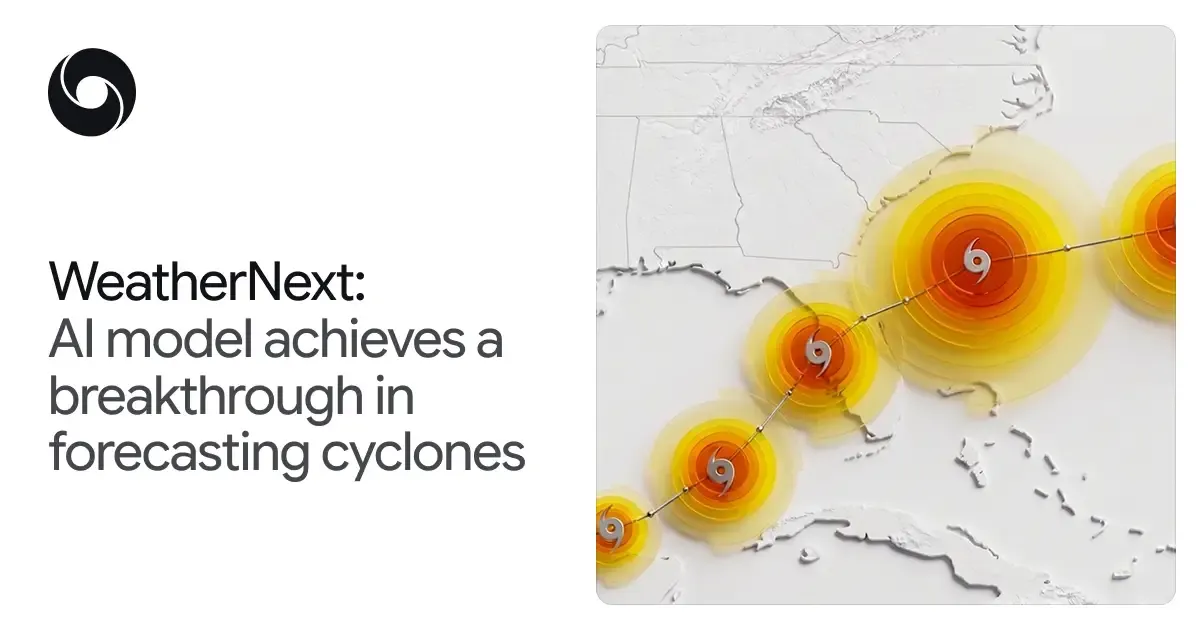
WeatherNext: AI model achieves breakthrough in forecasting cyclones
WeatherNext enables accurate cyclone forecasts that can give an extra day of warning. Now we are open sourcing the model.
More from the blog

From Atari to EVE Online: Building on 15 Years of AI Research in Games
Google DeepMind partners with game studios to prototype breakthrough AI gameplay.

How mobility gives language models a deeper understanding of place
Algorithms & Theory

When AI art has no author: Study finds generated images often can’t be traced to training data
A new method for surgically removing training examples from a model reveals that as datasets grow, the link between what a model learns and what it produces dissolves.

Multi-Vector (Late Interaction) Embedding Models with Sentence Transformers
We’re on a journey to advance and democratize artificial intelligence through open source and open science.
Related papers
A comparative review of modern large language model paradigms: GPT-4, BERT, Gemini, and DeepSeek
Comparison of GPT-4, BERT (bidirectional encoder representations from transformers), Gemini, and DeepSeek large language models (LLM), focusing on architectures, training methodologies, and real-world applications reveals GPT-4 excels in natural language generation and complex reasoning, supporting up to 128K tokens with moderate latency and higher costs making it effective for conversational artificial intelligence (AI).
Adaptive Repayment Optimisation for SME Lending: A Stochastic Programming Framework with Generative AI Explanation
The Adaptive Repayment Optimisation Engine is introduced, a novel framework that applies constrained stochastic optimisation to the design of loan repayment schedules for small and medium-sized enterprises (SMEs) and contributes to the operations research literature by bridging stochastic programming, explainable AI, and financial regulation in a novel application domain.
LLMs Leak Training Data Beyond Verbatim Memorization: Extraction via Membership Decoding
The Membership Decoding method is a plug-and-play replacement for standard decoding that requires only black-box token probabilities, and a new token-level membership inference method is proposed by leveraging likelihood from reference models, shifting the generation from the original token distribution to the member token distribution.
A Multiagent Large Language Model–Based System for Early-Stage Building Layout Planning
A multiagent large language model (LLM)–based system for early-stage building layout planning, which enables flexible design requirement inputs and robust spatial reasoning and demonstrated significant improvements in both geometric quality and semantic alignment over a baseline LLM-only system.