
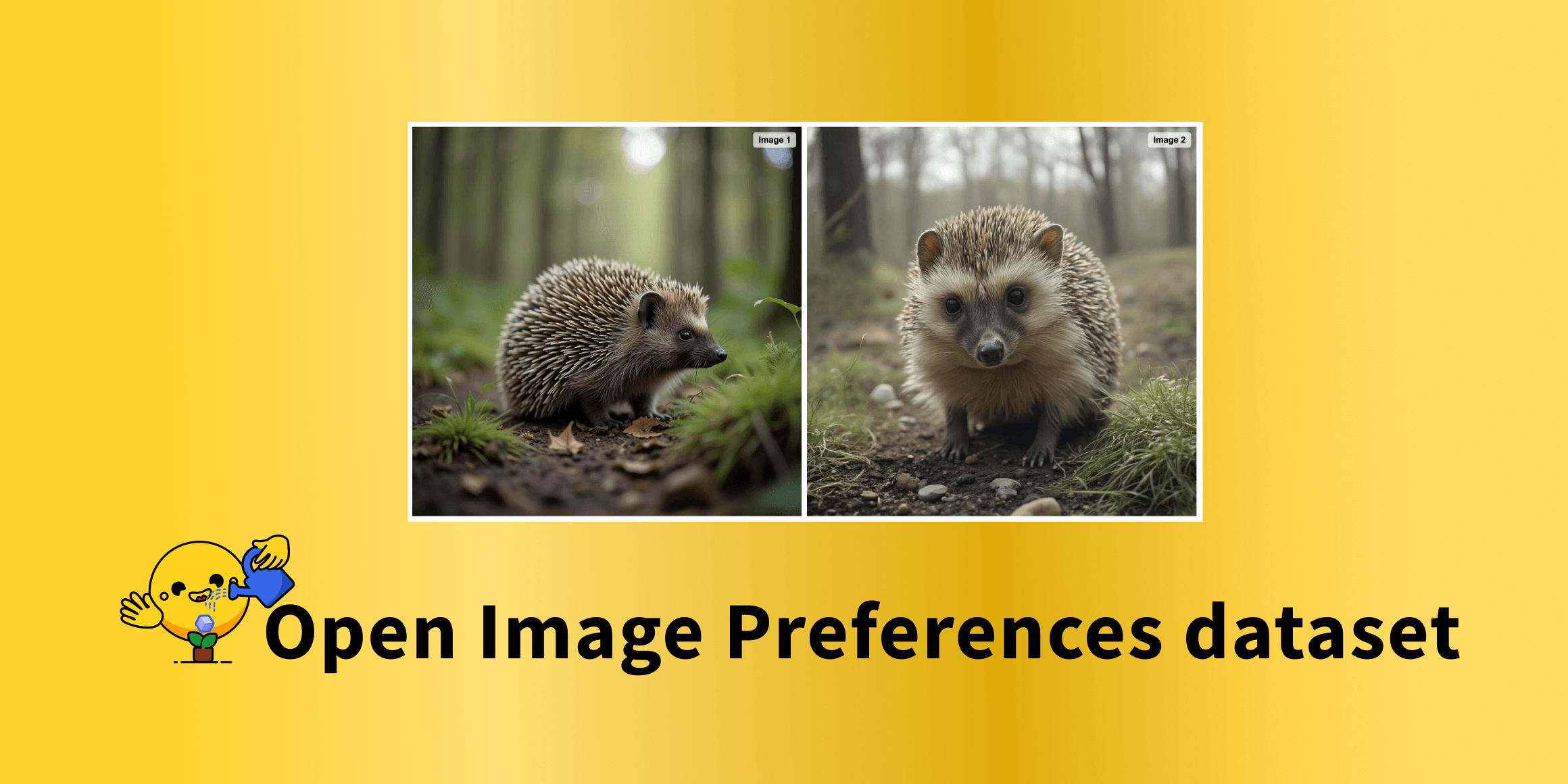
Open Preference Dataset for Text-to-Image Generation by the 🤗 Community
We’re on a journey to advance and democratize artificial intelligence through open source and open science.
More from the blog
 GPT-Lab
· gpt-lab.eu
Sep 17, 2026
GPT-Lab
· gpt-lab.eu
Sep 17, 2026
Beyond Prompt Engineering: The Role of Tacit Knowledge in Software Engineering
AI is making software generation faster, but speed does not remove the need for expertise. As more work is delegated to AI, tacit knowledge may become one of the most important human advantages in software engineering. The post Beyond Prompt Engineering: The Role of Tacit Knowledge in Software Engineering appeared first on GPT-Lab.
ToolGrad: Efficient tool-use dataset generation with textual "gradients"
Machine Intelligence
Training a coding model to paint watercolours with TRL and OpenEnv

Introducing @huggingface/kernels: 200+ WebGPU Kernels for Local AI
We’re on a journey to advance and democratize artificial intelligence through open source and open science.
Related papers
A Multiple Case Study of Artificial Intelligent System Development in Industry
This investigation revealed different types of AI systems and different AI development approaches, but it is common that business opportunities involving with AI systems are not validated and there is lack of business-driven metrics that guide the development ofAI systems.
Experimenting with Multi-Agent Software Development: Towards a Unified Platform
A unified platform that utilizes multiple artificial intelligence agents to automate the process of transforming user requirements into well-organized deliverables, including user stories, prioritization, and UML sequence diagrams, along with the modular approach to APIs, unit tests, and end-to-end tests.
Bridging Humans and LLMs: Investigating Human-AI Collaboration in Multi-agent Requirements Analysis for Organizational AI Adoption
LLM-based multi-agent systems can support strategic AI planning by enabling iterative refinement with human experts by supporting structured and collaborative Requirements Engineering processes for AI adoption planning.
ChargeNet: E(3) Equivariant Graph Attention Network for Atomic Charge Prediction
This work introduces an advanced equivariant graph attention neural network specifically engineered to model long-range atomic electrostatic interactions with high precision, and improves the model's accuracy, generalization, and robustness in complex scenarios.