Media Advisory: MIT to establish regional quantum hub
With $25 million investment from the Commonwealth of Massachusetts, MIT to build a new shared-use facility to serve as a statewide quantum toolbox.
More from the blog

Paving the way for greener ammonia production
New MIT research could lead to better materials for a fossil-fuel-free process for making the chemical that's essential to fertilizer and other products.
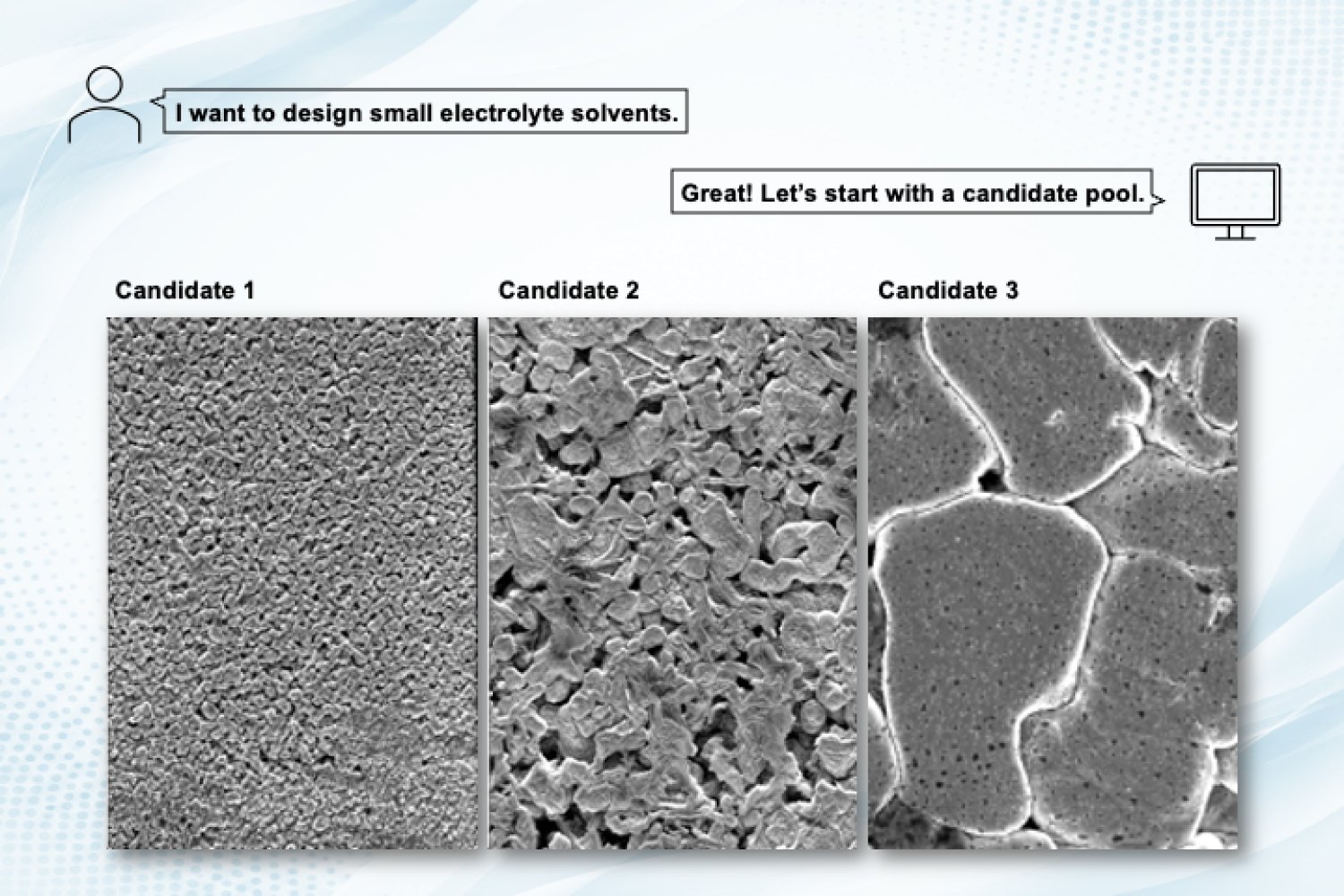
Solving the solvent problem
By focusing on electrolytes, MIT scientists are making sodium-metal batteries a more practical energy storage option.

Alexander Rakhlin named director of the MIT Statistics and Data Science Center
An expert in machine learning, statistics, and computation, Rakhlin succeeds Professor Ankur Moitra.

Daniela Rus receives Bavarian Minister-President's High-Tech Prize
Director of CSAIL and MIT professor honored for her contributions to robotics, artificial intelligence, and autonomous systems.
Related papers
Fermi-Dirac thermal measurements: A framework for quantum hypothesis testing and semidefinite optimization
Quantum measurements are the means by which we recover messages encoded into quantum states. They are at the forefront of quantum hypothesis testing, wherein the goal is to perform an optimal measurement for arriving at a correct conclusion. Mathematically, a measurement operator is Hermitian with eigenvalues in [0,1]. By noticing that this constraint on each eigenvalue is the same as that imposed on fermions by the Pauli exclusion principle, we interpret every eigenmode of a measurement operator as an independent effective fermionic mode. Under this perspective, various objective functions in quantum hypothesis testing can be viewed as the total expected energy associated with these fermionic occupation numbers. By instead fixing a temperature and minimizing the total expected fermionic free energy, we find that optimal measurements for these modified objective functions are Fermi-Dirac thermal measurements, wherein their eigenvalues are specified by Fermi-Dirac distributions. In the low-temperature limit, their performance closely approximates that of optimal measurements for quantum hypothesis testing, and we show that their parameters can be learned by classical or hybrid quantum-classical optimization algorithms. This leads to a new quantum machine-learning model, termed Fermi-Dirac machines, consisting of parameterized Fermi-Dirac thermal measurements-an alternative to quantum Boltzmann machines based on thermal states. Beyond hypothesis testing, we show how general semidefinite optimization problems can be solved using this approach, leading to a novel paradigm for semidefinite optimization on quantum computers, in which the goal is to implement thermal measurements rather than prepare thermal states. Finally, we propose quantum algorithms for implementing Fermi-Dirac thermal measurements, and we also propose second-order hybrid quantum-classical optimization algorithms.
TabularQGAN: a quantum generative model for tabular data synthesis
A novel quantum generative model for synthesizing tabular data by proposing a quantum generative adversarial network architecture with flexible data encoding and a novel quantum circuit ansatz for effectively modeling tabular data is introduced.
How Quantum Is the Advantage? A Fair, Calibration- and Noise-Aware Benchmark and Attribution Audit of Quantum Machine Learning for Network Intrusion Detection
A quantum-attribution audit is introduced that quantifies how much of any gain is genuinely attributable to the quantum component of quantum models, and attributes this to classical preprocessing and regularisation rather than quantum effects.
AlphaClifford: Efficient Clifford Synthesis and Transpilation with Model-based RL
AlphaClifford is introduced, a model-based Reinforcement Learning framework designed to efficiently synthesize Clifford circuits from the fundamental gate set composed of H, S, and CNOT, demonstrating the broad applicability of the framework on two additional tasks: hardware-constrained Clifford transpilation, where it outperform existing RL-based compilers, and as a post-synthesis optimization component within a full Clifford+T logical synthesis pipeline.