Hugging Face Models on Foundry Managed Compute
More from the blog

How mobility gives language models a deeper understanding of place
Algorithms & Theory
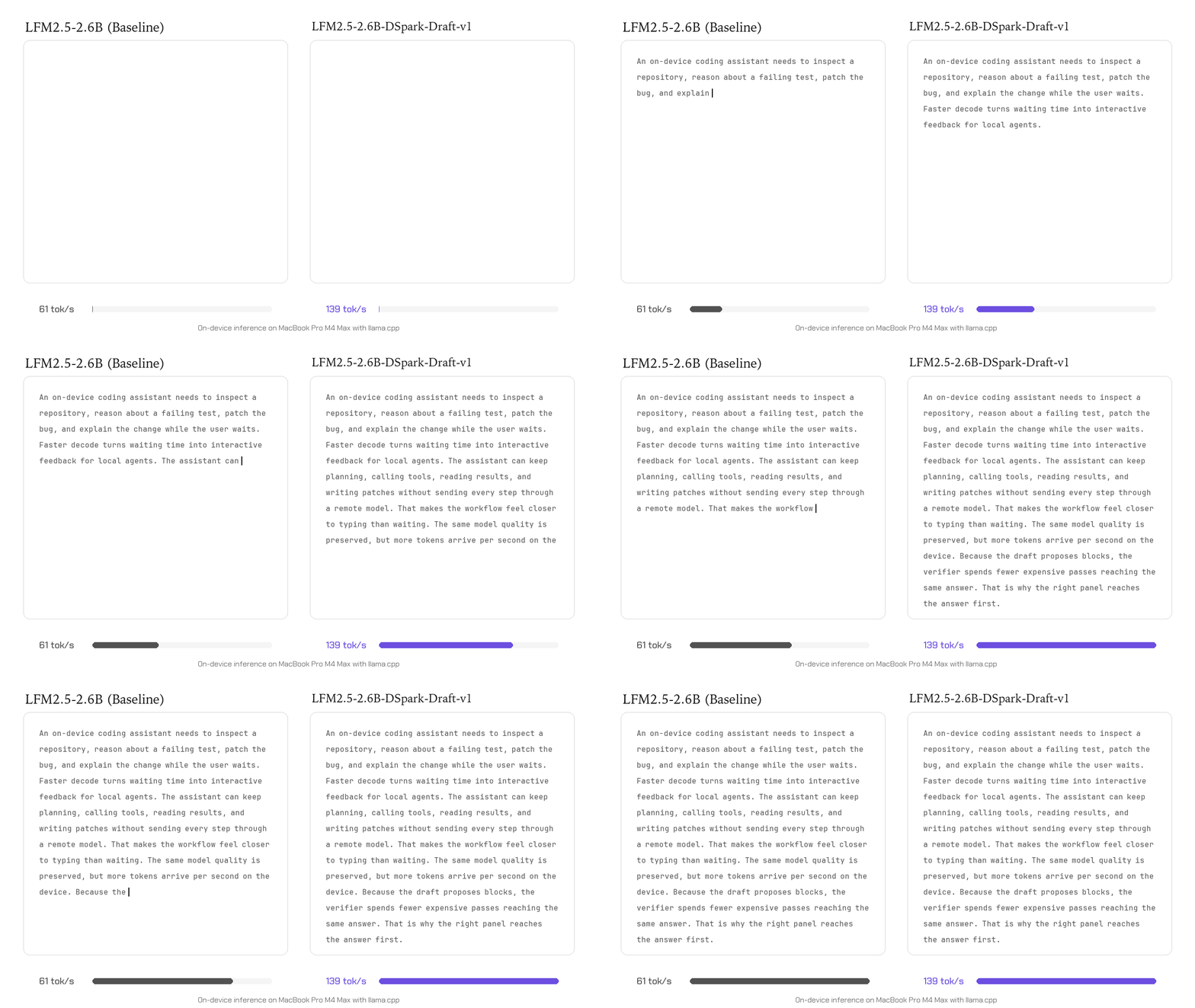
Up to 3.2x Faster Inference with LFM2.5-DSpark
A Blog post by Liquid AI on Hugging Face
How Much Memory Does Your Agent Actually Need?
A Blog post by IBM Research on Hugging Face

When AI art has no author: Study finds generated images often can’t be traced to training data
A new method for surgically removing training examples from a model reveals that as datasets grow, the link between what a model learns and what it produces dissolves.
Related papers
LLMs Leak Training Data Beyond Verbatim Memorization: Extraction via Membership Decoding
The Membership Decoding method is a plug-and-play replacement for standard decoding that requires only black-box token probabilities, and a new token-level membership inference method is proposed by leveraging likelihood from reference models, shifting the generation from the original token distribution to the member token distribution.
A Multiagent Large Language Model–Based System for Early-Stage Building Layout Planning
A multiagent large language model (LLM)–based system for early-stage building layout planning, which enables flexible design requirement inputs and robust spatial reasoning and demonstrated significant improvements in both geometric quality and semantic alignment over a baseline LLM-only system.
A comparative review of modern large language model paradigms: GPT-4, BERT, Gemini, and DeepSeek
Comparison of GPT-4, BERT (bidirectional encoder representations from transformers), Gemini, and DeepSeek large language models (LLM), focusing on architectures, training methodologies, and real-world applications reveals GPT-4 excels in natural language generation and complex reasoning, supporting up to 128K tokens with moderate latency and higher costs making it effective for conversational artificial intelligence (AI).
AoI Minimization in Heterogeneous MEC Networks: A Federated Learning-Assisted Hybrid DRL and Convex Approach
This paper investigates a dynamic heterogeneous mobile edge computing network (HMECN), where mobile devices (MDs) could offload their full tasks to a small base station (SBS) directly or the macro base station (MBS) in direct or relay mode. As age of information (AoI) is a comprehensive and accurate metric to capture the freshness of computation results, we formulate a long-term weighted sum AoI (LWSA) minimization problem in the HMECN by jointly optimizing the offloading decisions of MDs as well as the bandwidth and computation resource allocation of all base stations, subject to energy, delay and peak AoI constraints. To address the formulated non-convex mixed integer nonlinear programming problem, we decompose it into the offloading decision optimization (ODO) top-problem and the resource allocation optimization (RAO) sub-problem. Based on the decomposition, we propose a federated learning (FL)-assisted hybrid DRL and convex approach that is comprised of a safe multi-agent DRL algorithm, convex optimization and FL. The ODO top-problem is solved by the safe multi-agent DRL algorithm, which strictly ensures that the actions of each agent do not exceed its energy constraint and then paves the way for using convex optimization to solve the RAO sub-problem. FL is used to alleviate the training instability problem aggravated by multi-agent settings via breaking the limitation of partial knowledge for each individual agent. Simulation results demonstrate the superiority of the proposed approach in terms of the LWSA, convergence, scalability and robustness in dynamic environments.