Bringing Nunchaku 4-bit Diffusion Inference to Diffusers
More from the blog
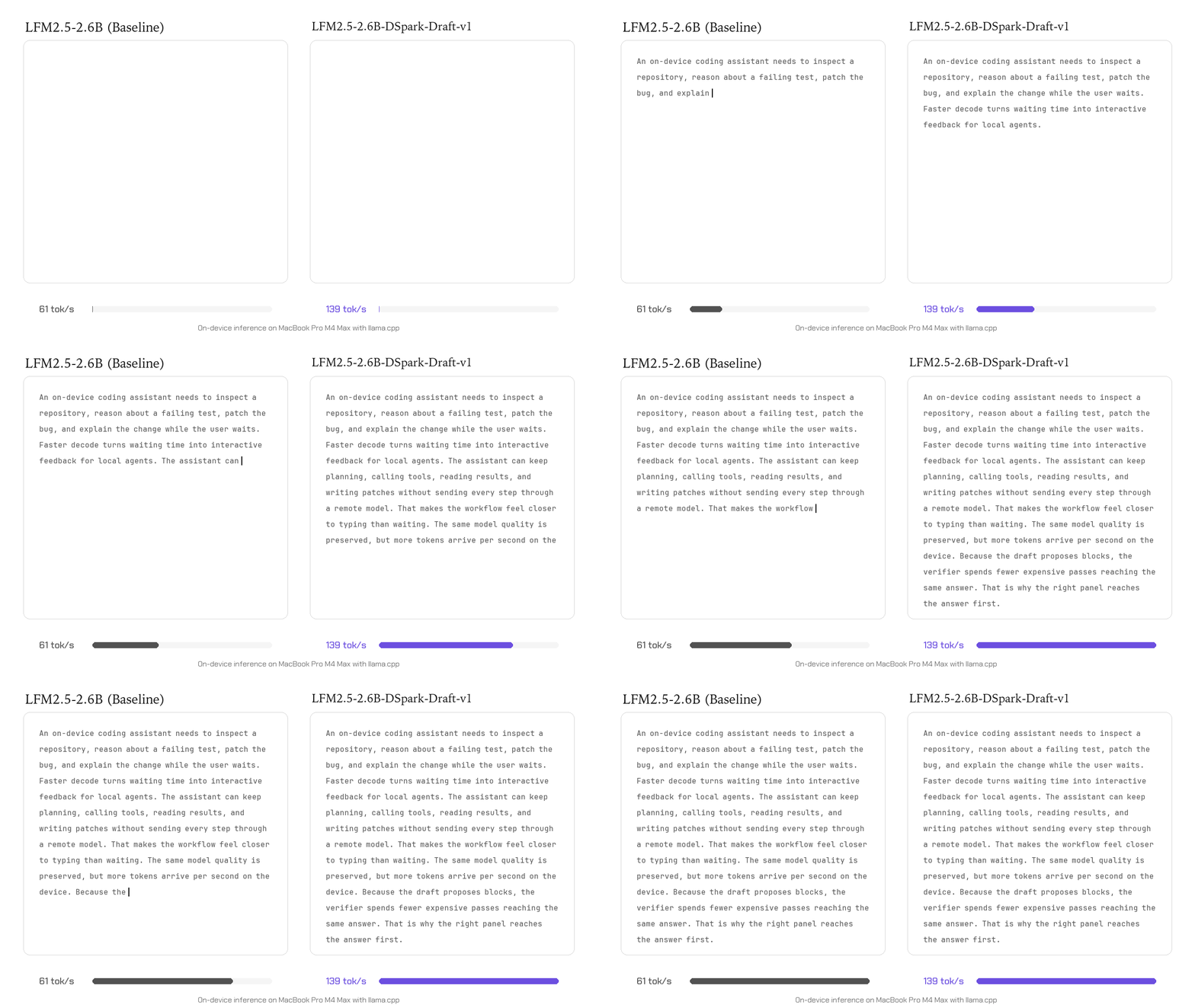
Up to 3.2x Faster Inference with LFM2.5-DSpark
A Blog post by Liquid AI on Hugging Face

Gemini Robotics 2 brings whole body intelligence to robots
From feet to fingertips — we are teaching robots intelligent whole-body control, fine dexterity, and teamwork to complete a broad range of complex tasks.
NVIDIA Cosmos-H-Dreams: Bringing Real-Time Generative Simulation to Surgical Robotics
Related papers
Modelling the impact of temperature on nanocarrier behavior: Thermodynamics, structural transitions, and drug release.
A rational design for next-generation thermo-responsive nanocarriers is proposed, in which polymer chemistry, nanoparticle structure, experimental characterization, and mechanistic modelling are integrated from the earliest stages of material development.
Modeling Environmentally Driven Seasonal Moisture Migration and Ground Movements in Expansive Clays
This paper describes the formulation of a numerical model for simulating environmentally driven one-dimensional (1D) ground movements of expansive clay. The formulation is based on a finite-element model that simulates the redistribution of matric suction through a diffusion-type equation, explicitly accounting for volume changes due to wetting and drying of the clay. We synthesize and modify highly nonlinear constitutive relationships for (1) hysteretic soil water retention; (2) reversible soil shrinkage and expansion of clay; and (3) hydraulic conductivity, explicitly incorporating desiccation cracks through a multidomain framework and assuming a critical surface crack depth. These models are well-calibrated to published laboratory tests on a reference expansive clay, Denver bentonite. We demonstrate capabilities of the proposed formulation to simulate the response of a homogeneous expansive clay to periods of drying and wetting, considering the initial matric suction, saturated hydraulic conductivity of the intact clay, and critical crack depth as three primary sources of uncertainty. We compare ensemble model simulations with measured ground movements from an instrumented expansive clay test site in Texas over a 3-year period using detailed records of potential evapotranspiration and precipitation. By assigning weights to the ensemble simulations based on their performance, we constrain the ranges of the three key uncertain parameters. The results showed very reasonable first-order agreement with the measured data and highlight the potential of the proposed formulation. We anticipate that more reliable predictions can be achieved through direct measurements of actual in situ evaporation rates and local soil properties.
CHAI – Compliant Human-centered Adaptive Interaction through Diffusion-based Language Trajectory Transformer
CHAI (Compliant Human-centered Adaptive Interaction), a novel language-driven framework for real-time modulation of a robot’s kinematics and mechanical compliance in real-world environments, introduces on-the-fly language-driven impedance (compliance) modulation along both translational and rotational directions.